
What kind of graphics of climate change do we need? As an aspiring environmental scientist and self-taught graphic designer, I set out – somewhat naively – to design climate graphics *otherwise*. I studied environmental science in my bachelors at the ETH in Zürich, then completed a masters in Transversal Design with the Academy of Art and Design in Basel and the Critical Media Lab. Somehow I became a social scientist instead.
What I'm going to share with you today is however are not climate graphics *otherwise*, but rather its detours into media theory, science philosophy, psychology and feminist and postcolonial thought.
This story illustrates the epistemological complexities of climate graphic design. My search for alternative designs, drawn together with the perplexing observation of their affective power over collective imagination vis à vis their apparent political impotence, has instead led me to critically assess the systems that select and disseminate climate graphics.
Emerging out of this research, I'd like to propose a hypothesis: Climate graphics have become a political technology that is remarkably well suited for maintaining the global, fossil-industrial status quo. This hypothesis is what I'm calling 'burnout by design.'
Now, I want to be careful with the use of the word 'Burnout:' Colloquially it's been adapted into popular culture where it denotes work overload and ensuing psychological stress, to which the response is some form of self-care. As María Puig de la Bellacasa notes with concern, these are usually individualised and commodified forms of care.1María Puig de La Bellacasa. Matters of Care: Speculative Ethics in More than Human Worlds. Posthumanities 41. University of Minnesota press, 2017.
Primarily the 'burnout' is a psychological-clinical term. Hannah Proctor, author of "Burnout: The Experience of Political Defeat" traces it's origins to psychiatrist Herbert Freudenberger in 1970s New York City: By day he treated well-paying clients in uptown Manhattan, by night he volunteered in free clinics downtown. It's in this context, treating patients and caregivers alike who operate crisis hot lines, women's houses or gay centers, that the term burnout first emerges to describe the co-morbid pathology of fatigue and cynicism that he witnessed in people setting out to make a difference but running aground on an unforgiving, apathetic system.2Hannah Proctor. Burnout: The Emotional Experience of Political Defeat. Verso, 2024.
The term burnout has notably been harboured into the context of social theory and philosophy, with the English translation of Byung Chul Han's 'Burnout Society:' Therein he posits that society now internalises the exploitative experience of capitalism, producing what he calls the 'achievement subject,' one doomed to burn out. 3Byung-Chul Han. The Burnout Society. With Erik Butler. Stanford Briefs, an imprint of Stanford University Press, 2015.
In the mode of self-reflection, I suppose my younger self unwittingly exemplified Han's achievement subject: I hoped that as self-taught graphic designer in an environmental science context I ought to be capable of prototyping alternative climate images; ones that address a host of concerns. But as Noemi Biasetton argues, designers today must be wary of the shifting tumultuous media landscape which they seek to transform with their art and design: In her book rooted in media theory she traces the development of a superstorm, a metaphor characterising the out-of-control social networking systems into which designers' visual artefacts are fed4Noemi Biasetton. Superstorm: Design and Politics in the Age of Information. Second edition. With Silvio Lorusso. Onomatopee 243. Onomatopee, 2025.: Here the designer-activist emerges as a potential subject of burnout.
But they're not alone: Climate science has had to put up with staggering levels of science skepticism, having to defend their work from malicious, well-coordinated attacks for decades. I've argued previously, in retracing the history of the climategate scandal of the 2000s, how this has pushed scientists towards more post-positivist paradigms of knowledge production 5Ponce de Leon, Inez, and Charlotte Kendra Gotangco. ‘Balancing Paradigms in Climate Change Communication Research to Support Climate Services’. _Handbook of Climate Change Communication: Vol. 1: Theory of Climate Change Communication_, 2018, 187–99., characterised by a science-first approach: Consequently critique-as-care is at risk of being conflated with hostile skepticism6Legrand, Guillemette, “World-Burning & Flat-Earthing – Rehearsing Pasts to Inquire about the Earth Otherwise,” Brand New Life Magazine; Magazin Für Kunstkritik, ahead of print, May 12, 2025.
Finally, the meaning of the word burnout in my title is also a nod to rampant environmental destruction, pushing ecosystems beyond their limits to adapt. For two decades now STS and feminist discourse have diagnosed the bifurcation of nature from culture as a fundamental crisis in the modern subject. In this spirit I'm not alone in putting psychological burnout into the same context as arid fields, forest fires and devastating mountain slides and flash floods, all of which bring to mind examples from just the last couple months:7Gielen, Pascal. ‘The Global Burnout’. In Sensing Earth: Cultural Quests Across a Heated Globe, edited by Philipp Dietachmair, Pascal Gielen, and Georgia Nicolau. Antennae – Arts in Society 31. Valiz, 2023. If we are to understand ourselves as a part of nature, witnessing its destruction must be seen as an experience of one's own undoing. However, in lieu of reckoning with this experience, it is relegated to subconscious dissonance and dissociation from the ecological reality.8Henrike Kohpeiß. “Respekt vor der Realität. Überlegungen zum Ungefühlten der ökologischen Katastrophe,” WestEnd – Neue Zeitung der Sozialforschung 22, no. 1 (2025); 21–40
Ok, so far I've set out to broadly define my use of the word burnout in the context of climate science, but how can I claim that this is by design?
I've found the practices for designing climate graphics to be troubled in a number of ways:
The design of climate graphics is dictated by conventions that are so entrenched, that the designers themselves are "…often unaware of the ideological underpinnings and conventions they use."9Helen Kennedy, Rosemary Lucy Hill, Giorgia Aiello, and William Allen. ‘The Work That Visualisation Conventions Do’. _Information, Communication & Society_ 19, no. 6 (2016): 715–35, p. 732. And in spite of the limited accessibility of scientific graphics10Walsh, Lynda. ‘The Visual Rhetoric of Climate Change’. _Wiley Interdisciplinary Reviews: Climate Change_ 6, no. 4 (2015): 361–68., resulting in confusion and misinterpretation 11McMahon, Rosemarie, Michael Stauffacher, and Reto Knutti. ‘The Scientific Veneer of IPCC Visuals’. _Climatic Change_ 138, no. 3 (2016): 369–81., designers are given little creative freedom, as decision makers insist on credibility over legibility. Further, within the IPCC, graphic schemas that have already been approved are likely to be approved again. Combined with limited resources on behalf of its authors this means that old designs are structurally favoured.
The exclusive faith put into a scientific, data-driven epistemology for producing sufficiently credible evidence to support climate policy is stubbornly persistent. As Lynda Olman argues, the impression of science and data as value-neutral is a psychologically soothing myth: It safeguards the delusion that climate policy can be achieved on the basis of inarguable, rational matters of fact 12Walsh, Lynda. ‘‘Tricks,’hockey Sticks, and the Myth of Natural Inscription: How the Visual Rhetoric of Climategate Conflated Climate with Character’. In Image Politics of Climate Change. Transcript Verlag Bielefeld, 2014.. As artist and researcher Tega Brain put it: "We use data to study problems that would be more effectively addressed through simple political action. The impetus to "study the problem" ad nauseam gives the appearance of addressing an issue while perfectly maintaining the present state of affairs."13Brain, Tega. ‘The Environment Is Not a System’. In Incomputable Earth: Technology and the Anthropocene Hypothesis, 1st edn, edited by Antonia Majaca. Bloomsbury Publishing Plc, 2026, p. 237. Publicly this translates into a political spectacle that in fact aims to bewilder while conveying the impression that the responsible parties have the situation under control – obfuscating that in many ways they evidently do not.
This rather familiar story of epistemic authority is deeply concerning in conjunction with the particular ways of knowing and seeing of climate, the planet and collective futures that are manifested in these graphics. Climate graphics with their recurring visual rhetoric of breaking safe limits and envisioning future Earth as a burning wasteland are eschatological representations of particular, situated imaginaries for "what a hot, burning earth should look like."14Guillemette Legrand. ‘World-Burning & Flat-Earthing – Rehearsing Pasts to Inquire about the Earth Otherwise’. Brand New Life Magazine: Magazin Für Kunstkritik, ahead of print, 12 May 2025, Rehearsing Pasts I. This leveraging of a particular, cultural semiotic association to heat and fire evidently works: In an empirical study, participants associated "alarm, uncontrolled heat, fire, drought [and] boiling over"15Schneider, Birgit, and Thomas Nocke. ‘The Feeling of Red and Blue—A Constructive Critique of Color Mapping in Visual Climate Change Communication’. Handbook of Climate Change Communication: Vol. 2: Practice of Climate Change Communication, 2018, 289–303, p. 298., thus inviting imaginaries of destruction, doom and collapse: Mental burnout as a result due to the impossibility of grasping the immensity climate change as an object of knowledge, leading to cognitively short-cutting to the culturally readily available narratives of hell on earth, which precedes and coincides with ecosystem burnout16Birgit Schneider. ‘Burning Worlds of Cartography: A Critical Approach to Climate Cosmograms of the Anthropocene’. Geo: Geography and Environment 3, no. 2 (2016): e00027.
Here we can build a bridge back to the psychological condition discussed earlier: As philosopher Henrike Kohpeiß argues, "doing what needs to be done about climate change isn't failing because of a lack of knowledge or because we lack solutions. Rather that knowledge is ineffective because of affective defence mechanisms that shield us from acknowledging our share reality"17Kohpeiß, Henrike. ‘Respekt vor der Realität. Überlegungen zum Ungefühlten der ökologischen Katastrophe’. WestEnd – Neue Zeitung der Sozialforschung 22, no. 1 (2025): 21–40, p. 23.. Climate graphics, loaded with cultural-semiotic symbols denoting planetary purgatory – as unintentional as it may be – only exacerbate this circumstance.
The result is an affectively powerful media artefact, embedded in a deeply hegemonic visual culture that is locked into reproducing the inaccessible features and undesirable narratives harboured within. With each iteration a concerning ontological planetary paradigm sediments itself into the cultural imaginary for what our future can look like, and what strategies come into question for achieving it. By shaping what about the planet matters, images of current and futures Earths recursively transmute matter itself into that image;18Turšič, Miha, Zoénie Liwen Deng, Bonnie van Vught, et al. More-than-Planet Atlas. Edited by Lukáš Likavčan and Gary Carter. Stichting Waag Society, 2025. one that renders Earth as a "passive depository of resources."19Lukáš Likavčan. Introduction to Comparative Planetology. Strekla Press, 2019, 43.
What the hypothesis of 'burnout by design' suggests, is that this framing is purposeful: Recognising the hegemony of the visual sphere, the constellation of circumstances is remarkably well-suited for maintaining the present state of affairs: Its mechanisms are
- the iron grip on epistemic authority,
- the impetus to study the problem ad nauseam, hoping vainly that somehow more data will find a solution that doesn't involve radically reshaping our mode of life,
- the immobilising effects on publics
Nonetheless, the trouble lies in doing something radically different. It follows that radically different onto-epistemic relations to the planet will produce an equally radically different visual language. One that I'm convinced is being developed everywhere, except that because of its very nature of rejecting restrictive scientific conventions and affectively supercharged cultural-semiotic inferences, it's not immediately recogniseable as such.
This text was prepared and broadcast on the I Never Read Radio "You Never Listen" in June 2026. You can listen to the recording here.
At the end of March this year I was invited to a residency that sought to link cultural practitioners that care about climate change, called 'Creative Climate Changemakers.' It was organised by the British non-profit Julie's Bicycle in coordination with the Swiss alliance for sustainable culture "Vert le futur." 24 artists, designers, researchers and members of various cultural industries came together to talk and organise. Emerging out of that week, I found myself in group of wonderful creatives, loosely concerned with the direction of traditional institutional responses to climate change, particularly academic ones, wanting to build something different; something that worked for us. As a collective matter of concern we focussed on narratives in Swiss culture and national identity: How can we tell common stories for the sort of futures that we want? We began framing our project as the Institute for New Narratives, but also associating words like 'para-siting' or para-school and thus landed on the project title para-narra: The prefix para- meaning next-to and narra as an abbreviation of narratives.
As we started to dream towards what we wanted this to look like, and crucially, what we didn't want it to look like, a matter of concern that crystallised for me was its organisation: Whether it's a school, an institute, or something else, it's an institution of some form. And that set off my critical thinking alarm bells. Particularly as we want to do something new, critical, decolonial; I'm worried that the Swiss mentality of institutionalism steers these efforts into a place that actually dilutes our ability to do that. Where institutions are often set up to protect something old, how can we use it to make something new?
So what I proposed to discuss here is to walk through my thought process, while drawing on some reading I'd done, as I try to hone in on this concern of mine. Doing this, I'm also drawing on my experience in a self-organised collective, the megafon. We publish a newspaper once a month out of the Reitschule in Bern, and have been doing so since 1987. It's therefore hard to say that this isn't an institution in its own right, but it's one that I'm comfortable with. In contrasting my experience in an autonomously organised collective with critical literature that ruminate on whether to trust institutions or not, I'm hoping to find some direction as we in Para-Narra try to do something new.
I know that I was raised in such a way that engendered skepticism towards institutions: My parents explained to me that they didn't sign me up for scouts even though all my school-friends were there because they didn't like that I'd have to wear a uniform. Scholarship, and the wider trend in critical thought over the past couple decades also teaches criticality towards institutions, especially ones that purport to be critical, but beyond a vague skepticism I realised that I had trouble putting a finger on why exactly, and what I'm supposed to do with that.
Going towards what I'm unsure about and investigating those uncertainties usually yields fruitful insights. And so I hope that by sharing them, I might help others relate and disambiguate their own concerns with what a critical institution these days can look like and what it ought to be wary of.
As previous critical theorists have reflected, institutions are actually a remarkably difficult to define. Broadly speaking I would say that institutions are general forms of organisation: Every school is an institution but not every institution is a school. Institutions also transcend organisational levels: A school can be composed of several institutes, while itself being an institution. They also transcend the barrier between public and private: When we speak of the institution of marriage, we mean a culturally-derived framework for structuring people's interactions. Participating in an institution means letting it direct and structure your movements, your decisions, your actions, your plans; consciously or subconsciously. As sociologist and philosopher Bruno Latour points out: Institutions are shaped by its subjects but the subjects are also shaped by the institution. As I will discuss later on, this creates ambiguous outcomes; for better or for worse.
Out of this argument, that institutions shape individuals, arises the suspicion that for critical practitioners, if their critical practice becomes subsumed by the institution, that it directs the outcome of their intervention towards ends that don't match up with the intentions anymore. Alternatively, critical practitioners refusing to subscribe to an institution, instead characterise them as monumental obstacles and nefarious infrastructures that by sheer mass and momentum inhibit cultural transformation.
According to filmmaker, artist and writer Hito Steyerl, this characterises the first wave of institutional critique in the 1980s: Cultural institutions like museums fell under the ire of concerned cultural actors and critical thinkers, who determined that they had taken on governmental functions, like building national identities by narrating certain histories over others. As such, museums are thought to help stabilise and normalise the authority of nation states, or as a matter of fact any elite group that is concerned with maintaining their authority. As philosopher Henrike Kohpeiss recently argued, the capacity for self-criticism is a much lauded quality of bourgeois subjects, which is too often deployed to feign concern and critical reflection, but above all acts to protect the subject's own sovereignty and epistemic authority: What matters is the degree of critique. Just enough to portray the ruling class as self-critical, conscientious and sensitive, but not enough to put their authority into question.
Around the 2000s cultural institutions were subject to a broader development of economisation. Cultural institutions were now made to perform under the pressures of the market, just like a business. Critique also became more all-encompassing, focussing on representation in cultural institutions as the prime matter of concern: The outcome was atomisation, fragmentation, symbolic representation, and a spectacle of cultural difference and ethnic variety. Allowing institutions to represent themselves as 'green', 'queer' or 'inclusive' enabled them to respond to societal critique in way that achieved very little structural change.
Steyerl concludes their 2007 article by determining the effect of the economisation of critical cultural institutions, and I fear it is a familiar story to many of us: Precarity, flexible work times, temporary projects and self-employment are all characteristic of cultural industries still today. Making a living with critique is easier when that critique is palatable to the powerful. Who can even afford to be critical nowadays?
Returning back to the beginning, it seems apparent that developing new narratives ought to be a task that should be as free and untethered to existing norms and expectations as possible. I'm reminded here of Hannah Arendt's famous phrase with which she characterised her philosophical practice: 'thinking without a banister:' Indeed this seems like the proper model to adopt here, but it is one that postcolonial and feminist thinkers have trained us to be critical of. It is tempting to think that there is no banister, that the practice of philosophy is pure and in its orientation designed to produce a universal truth, but that is the inheritance of a colonial epistemology: One that centres the well-educated, European subject, thus laying an ideological ground for colonisation of others. Critical scholars today are skeptical of Arendt's 'thinking without a banister:' Paying close attention to who Arendt ascribes political agency to, and who she does not, one realises that she is in fact holding on to the banister of a bourgeois European subjectivity. This is brought to bear in the epistemic certainty and philosophical authority of false universals: The generalisation of political, social and cultural realities of white, educated Europeans to, in this case, African-American schoolchildren in the United States after the Civil Rights Act was passed.
As we set out to build an institution for new narratives I think it is a dangerous fairy tale to imagine that we can do so completely liberated from prevalent norms. One might also associate feminist scholar Jo Freeman's famous article 'the tyranny of structurelessness (1970):' If one fails to formalise the informal bonds and alliances in social movements while blindly insisting on an ideology of structurelessness and horizontal governance, movements become ruled by those informal structures. Similarly, an institution will be structured by previous paradigms, cultural habits and legal systems either way. One can either acknowledge that and work with it, or omit attending to that and instead be led towards familiar and dubious outcomes.
A host of troubling questions – that I think are worth being troubled by – present themselves: What banisters are we holding on to today? What ways of instituting do we insist on blindly, just because they're familiar, safe and the legal infrastructures necessary for creating and managing an institution for them are already in place? What path dependencies does that create?
In Switzerland, in terms of formal organisation, a number of options exist for forming a legal entity, some of them more complicated than others: A corporation made up of stocks (Aktiengesellschaft), a GMbH (limited liability company), an association, a collective, a foundation and all the various forms of institutions that are embodiments of public law, such as a university. In terms of legal status and how that shapes institutional habits I'm extremely unfamiliar with most of these, except for the collective. It's remarkably easy to set this up. Likewise when Jamie Allen and Bernhard Garnicnig reflected in 2019 on the process for setting up a so-called 'forening' in the Danish context, they remarked on how simple the process was to formalise oneself as an institution in a national context.
But even with this simplicity, they arrive at a similar concern as I do: "[…] [I]s it even possible to develop a critical institutional practice in the context of well-oiled, widely accepted and lauded forening-style institutionalism? If the energies required for critical institutional practices come, at least in part, from the inevitable frictions against or within state or societal organisational structures, can these really take root in contexts rife with such smoothly operating institutions, and sophisticated outlets of institutional frustration?"
Before trying to respond to this by reflecting on my work in the megafon newspaper collective, I want to open up another important consideration:
Much like the economisation of cultural institutions in the 1990s and 2000s, the debate on climate policy undertook at similar development around the same time: As climate scientists presented serious concerns to governments and private industries, they in turn looked to economists for answers. Thus the register that we have gotten used to talking about adaptation and mitigation to rising greenhouse gas emissions is characterised by economic instruments and technological solutions, that those same industries get to be a part of.
It's a reminiscent story: Critique will only be accepted if it doesn't upset the status quo.
Focussing on Switzerland's responses to climate change, using national referendums as an indicator, I observe how initiatives towards capitalist, industrial futures are accepted, such as the Stromgesetz from a two years ago, while initiatives that are intent on more radical investments (like the Klimafonds-Initiative from earlier this year) or protecting biodiversity are rejected. Obviously the Swiss People's Party's heinous, ecofascist Sustainability initiative that was rejected by Swiss voters June 14th, 2026 fails to answer any climatological concerns, but we could similarly understand it's stern rejection as a vote of confidence for Swiss business and industry, which would have been severely hampered by the initiative.
Today experts on climate change at the highest levels are proclaiming the need for root-and-branch transformations of our societies and economies, if we are to curb emissions enough to avoid catastrophic outcomes. As Stefan Schäfer, scholar of science and technology studies from the Potsdam Research Institute for Sustainability argues, (quote)"what is required is to move beyond the institutional and epistemic frameworks through which we have historically come to understand climate change as a political challenge." (end quote) He acknowledges that this is unsatisfying, frustrating and unintuitive, given how we have learned how to work towards a solution for climate change. As tempting or psychologically soothing as it may be to adhere to existing infrastructures and paradigms, we need to challenge the idea that there can even be a definitive solution to climate change: We are going to be living with severe changes to planetary systems either way.
One register, that as Julie's Bicycle who coordinated the Creative Climate Changemakers residency argues, has been ignored in the context of climate policy for far too long is culture. Until recently culture was completely omitted from the proceedings of the Conference of the Parties, which is the main intergovernmental structure for world leaders to coordinate climate policy. So it seems like there might be a unique and pressing opportunity here in bridging culture and climate in the shape of a critical institution. But what should that institution look like?
Jamie Allen and Bernhard Garnicnig conclude their article by pointing towards the Danish, self-led, assembly-based form of instituting as a promising format:"This lies in a particular flexibility to diversify responsibility across collectives; to proliferate and adopt methods while helping to equalize agencies, energies and temporal resilience. New institutional forms show promise, acting as countermeasures to a contemporary landscape that is marked by the creative destruction wrought through austerity, conservatism, supervision and economization."
I read these words and they echo my experience in the megafon newspaper collective. We are located in the Reitschule in Bern, an autonomous cultural space that was progressively claimed and established as such in the 1980s, in the wake of youth uprisings all across Switzerland. In 1987 the megafon established itself therein, in coordination with the in-house printer, the 'Drucki', and published a weekly dispatch in the form of a zine, from the front lines of the youth movement, so to say. And it has continued to this day, with infrequent breaks, as a collective organisation, with ups and downs and never going above 1500 copies. As a legal entity, we are a 'Verein' that is located within the structures of the Reitschule, but for as long as I've been part of the collective, six years now, we have mostly just published whatever we wanted to publish. In terms of structure, whoever can take time out of their day meets on a weekly basis to discuss the day-to-day business and ensure that by the monthly printing date, we have a completed magazine. Beyond that we organise a retreat three times a year to discuss general structures, questioning our institutional form and creative direction. The composition of the collective is also notable: We aren't funded by anyone outside of the Reitschule, and only selling 1000 copies monthly barely pays the printer's bill. So we work for free, which has consequences for our composition. Again, who can afford to be critical? In our case its a bunch of young students and activists with some other financial support system and enough spare time to dedicate to this project. We acknowledge how this limits the number of perspectives we're capable of representing.
One question we ask ourselves on every retreat: Who are we doing this for? And for the most part, we seem to arrive at the conclusion, that we're simply doing it for ourselves. Why? It's a place for us to make sense of our lives together, according to certain protocols and adhering to certain calendar dates (most notably the printing date). We consider our work as activist; a publishing platform that is as autonomously self-organised as we can make it: It's an infrastructure for publishing perspectives that give left-wing activist movements, and ourselves of course, a more direct voice and a platform.
I saw a comment online a couple days ago which argued that sociopolitically it must be acknowledged that activist strategies like demonstrations for the most part actually do very little to move the political needle. What they do very effectively however is strengthen the protestors resolve, embolden them, help them structure their political beliefs and give them a community. Similarly, a couple months ago I attended a discussion among various experts researching youth movements. One of them talked about burnout among climate youths; the persistent feeling that one's activist work is never quite good enough. What her research documented was that formal and informal spaces practicing care by allowing for frustrations to be articulated and validated among peers helped individuals continue engaging in activist work: Care among peers as an infrastructure preventing activist burnout. One might say that so much of what we, who often lament the bubble that we're in and the complicated, semantically restrictive conversations we have and publications we produce function in this manner. We organise reading groups and and parties and symposia and book fairs to congregate, strengthen community and often uncertain political subjectivities. All that to say, an institution can serve an important role if it's purely in service to itself.
Conceptualising institutions as infrastructures of care, I'd like to conclude by offering an ecological metaphor to think of institutions with:
Institutions are temporary forms of structure: independent political, economic, cultural and social vectors that come together out of common cause to organise oneself. In a similar form, can we understand, say, a tree as an institution, as in, a temporary organisation of matter in such a way that enables and enriches life around it. It can grow, but unlike a human body, they grow in an indeterminate form: You cut off a branch, and two new ones will grow. Institutions should be adaptive like that, and receptive to the needs of their constituents, especially as its subjects change. They emerge out of possibility in vibrant matter and given time, they succumb to age, deteriorate and wither. But not without their matter and energy being appropriated into other lifeforms and new emerging structures.
Using this metaphor, I'm interested in building an institution that emerges out of existing energies, interests and concerns. It's true that all of us must fend with more or less precarious livelihoods, but the megafon has persisted through precarity for nearly fourty years. Looking at plants, that also doesn't necessarily spell disaster; the greatest diversity of species after all is found in nutrient-poor soil, whereas rich soil means that whoever is most able to appropriate its nutrients will come out on top. I don't want to romanticise precarity, but more so highlight the exceptional nature of critical cultural work in spite of it.
I'll conclude with an anecdote: In the residency I had a heartening exchange with Alison Tickell, the founder and director of Julie's Bicycle. She said, that what we're doing is dwelling in the critical zone, on the edge: It has sparse vegetation and it's terrain is rocky and in many parts polluted with petromodern paradigms and hostile infrastructures, but it is a terrain we are intent on reappropriating. Feminist science and technology scholar Maria Puig de la Bellacasa frames the reappropriation of care practices similarly: It's crucial to acknowledge the "poisons in the ground rather than expecting to find an outside alternative, untouched by trouble, a final balance – or a definitive critique." So we till the soil on the edge, uncertain of what on earth we're even doing here, but in kinship with nettles, brambles and collaborators find ways to make sense of it all together, while we work on enriching the soil to sow the transformative seeds that we wish to grow. That's an institution I could get behind.
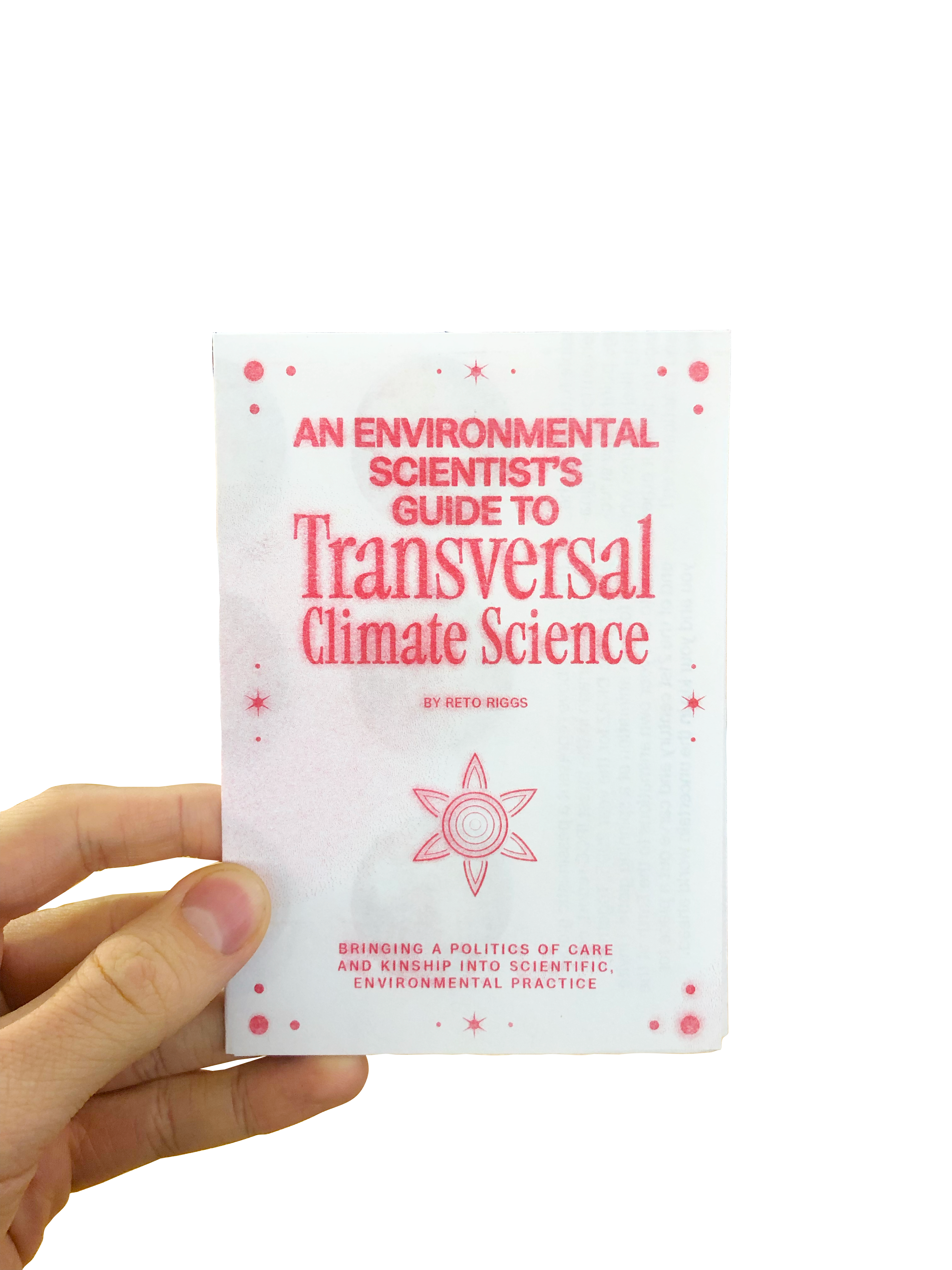
The ancient Babylonian world map, dated to the 9th century BCE structures the known world inside of a circle. Beyond lies the unknown, which is graphically alluded to with six triangles. The graphic on the front page is a diagram that approximates the Babylonian world map.
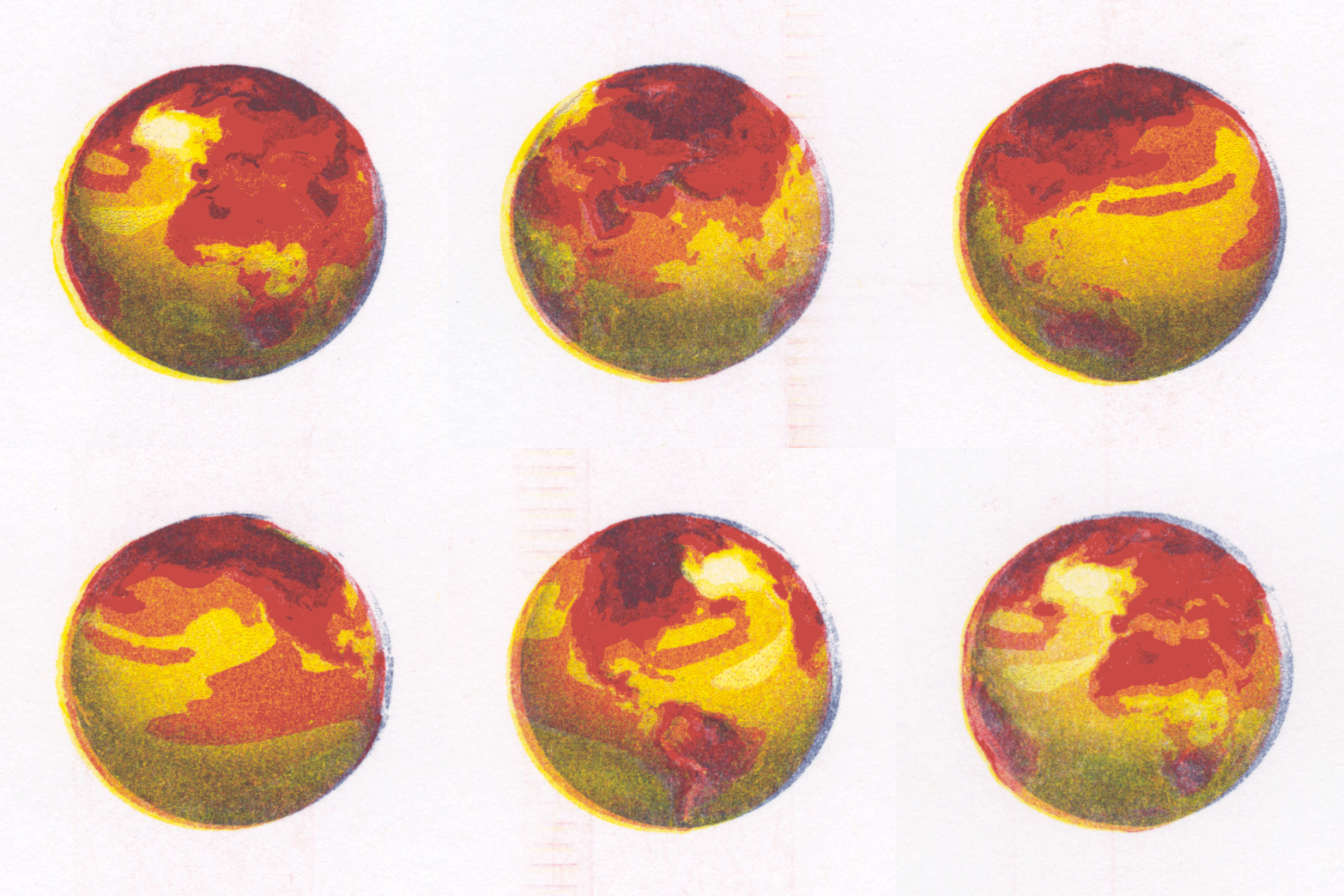
By contrast, contemporary maps, in particular climate maps depicting possible futures for the Earth leave no space for intervention or imagination. From impossible vantage points they structure space and time, delimiting likely futures while eclipsing the conceptual space to define it otherwise. What sorts of politics and practices aren’t represented in these graphics?
For the exhibition Iridescence – A Spectrum of Research Practices from September 10.–14. 2025, I produced an A3 riso print, which folds into an eight page zine. Outlined therein are the corner-points of my research for the thesis Speculating Towards a Transversal Environmental Science. On the back is a poster, consisting of a 48 frame animation of a spinning globe. The exhibition featured a table with the riso-prints, a print-out of the thesis “Speculating Towards a Transversal Environmental Science,” and other related printed matter, a wall projection of the animated, spinning globe and three prints mounted on the wall. The printed poster formed the foundation of a workshop that occurred on September 13. 2025, where interested participants gathered around the table to draw and paint over the apocalyptic landscape depicted in the climate graphics, adding blues and greens to represent a future worth living in and fighting for.
Dass heute weiterhin fossile Infrastruktur gebaut wird, dürfte eigentlich, im Anstreben verheerende Folgen durch den Klimawandel vorzubeugen, nicht passieren. Und doch wird weiter investiert. Öl- und Gasunternehmen schlagen Rekordprofite. Blanke Einfallslosigkeit der internationalen Klimapolitik ist das aber nicht. Dahinter steckt eine gefährliche Strategie, mit dubiosem wissenschaftlichem Rückhalt.
Ursprünglich publiziert im megafon Nr. 519, September 2025. megafon.ch
Laut dem Soziologen Bruno Latour macht der Klimawandel alle zu Migrant*innen. Während wir in der Schweiz das grosse Glück haben, in unserem zuhause zu bleiben, wandern uns der Boden unter den Füssen, die Pflanzen und Tiere weg. Gegen Ende des Jahrhunderts soll sich hierzulande ein mediterranes Klima einpendeln. Das «schweizerische» Landschaftsbild rückt indes, ungeachtet der Landesgrenze, nach Norden.
Während dieser Vergleich die allumfängliche Wirkung des Klimawandel erschliesst, dürfen die Herausforderungen für ‘einheimische’ Migrant*innen nicht gleichgesetzt werden mit gewaltvollen Fluchterfahrungen von Menschen, die ihre Heimat verlassen müssen. Klimabedingt wird die Zahlen flüchtender Menschen in die Höhe schnellen. Unerträgliche Hitze, Wassermangel und Ernteausfälle drängt Menschen in mildere Breitengrade, was den Klimawandel auch zu einem demografischen Wandel macht. Vor diesem Hintergrund bleibt zu hoffen, dass das europäische Migrationsregime einen radikalen Paradigmenwechsel erfährt. Die abschottende europäische Migrationspolitik droht im Zuge ihrer eigenen verfehlten Klimaziele die Gewalt-Eskalationen im Mittelmeerraum weiter zuzuspitzen.
Klimaaktivist*innen drängen schon lange, «System Change not Climate Change». Die Forderung nach dem Systemwandel konkretisiert sich hinsichtlich der Migration von Lebewesen in eine unausweichliche Verpflichtung: Angesichts des unabwendbaren Wandels irdischer Lebensräume, müssen wir alle unser Zusammenleben neu ausloten. Was dabei hoffentlich klar ist: Zu den politischen Akteur*innen dieser ökologischen und demografischen Umwälzung in der Schweiz, zählen nicht nur Schweizer Stimmbemächtigte.
Doch gerade in einem Wirtschaftssystem, das mit grenzenlosen Konsummöglichkeiten fürs persönliche Glück lockt, ist das eine enorme gesellschaftliche Herausforderung. Wenn kollektive Bedürfnisse – etwa die Unterbindung lebensgefährlicher Hitze – durch individuelle Konsumgüter – Klimaanlagen – befriedigt werden können, wer soll da noch mühsam mit Andersgewillten verhandeln wollen? Gleichzeitig birgt diese Situation auch grosses revolutionäres Potenzial unsere Lebenswelt anhand fürsorglicher und respektvoller Prinzipien neu aufzubauen.
Dass der Begriff Revolution mittlerweile auch im Wortschatz von sonst nach Neutralität bemühten Wissenschaftler*innen zu finden ist, lässt aufhorchen: So verkündete etwa der renommierte, britische Klimawissenschaftler Kevin Anderson im noch renommierteren wissenschaftlichen Journal Nature: Während in den 1990er Jahren ein moderater Eingriff in unser Wirtschaftssystem genügt hätte, um den Klimawandel wirksam vorzubeugen, benötige dieses nun «einer revolutionären Überarbeitung.»
Ähnlich ausdrucksstarke Sprache fliesst auch ins Vokabular einflussreicher, internationaler Institutionen. Das Umweltprogramm der Vereinten Nationen (UNEP) hält fest, dass «weitreichende, gross angelegte, rapide und systemische Transformationen» jetzt essenziell seien, «um die Pariser Klimaziele [von 1.5°C] zu erreichen.» Auch die internationale Energieagentur (IEA), ein Organ der OECD-Staaten, sorgte 2024 für Aufsehen: Es verkündete, ab sofort dürfte absolut null weitere fossile Infrastruktur gebaut werden, um katastrophale Klimaveränderungen vorzubeugen.
Konträr dazu genossen Kohle-, Öl- und Gasunternehmen seit 2020 ihre profitabelsten Jahre überhaupt: So witzelte etwa der Finanzchef von BP im Jahr 2021, sie hätten mehr Geld verdient als sie wüssten, was sie damit anfangen sollen. So werden munter neue Ölfelder erfasst, zu deren Ausbeutung immer aufwendigere, teurere Infrastruktur gebaut werden muss. Die Förderung von fossilen Brennstoffen wird immer schwieriger. Das führt aber paradoxerweise nicht zu einer schwindenden Nachfrage, sondern zu höheren Renditen.
Demgegenüber befindet sich der Preis pro Kilowattstunde Strom aus erneuerbaren Energieträgern – etwa Photovoltaik oder Wind – seit den 2010er Jahren in freiem Fall. Sonnenlicht ist mittlerweile der billigste Energieträger überhaupt. Trotzdem gelang es der Photovoltaik nicht, ihren Marktanteil auszubauen. Die frustrierende Ursache liegt an der Logik des Marktes, in der sich erneuerbare Energieträger durchsetzen müssen. Anders als Öl und Gas sind Strom aus Sonnenlicht oder Wind nicht mit begrenzt: Es muss niemand arbeiten damit die Sonne scheint oder damit der Wind bläst. Sie sind eben erneuerbar, gratis und deren Verfügbarkeit ist nicht mit gefährlicher, teurer und zerstörerischer Mobilisierung verbunden.1 Es ist hier zurecht einzuwenden, dass für Photovoltaik und Windkraftanlagen auch seltene Erden und Metalle gefördert werden müssen, deren Abbau und Weiterverarbeitung mit Naturzerstörung und gefährlichen Arbeitsbedingungen einhergeht. Allerdings besteht hier ein wesentlicher Unterschied: Die Rohstoffe müssen pro Anlage nur einmal abgebaut werden. Sollte unsere Energiewirtschaft also der Logik des endlosen Wachstums entkommen, bleibt die Hoffnung diesen ausbeuterischen Bergbau in nicht allzu ferner Zukunft einstellen zu können. Inzwischen bleibt es unsere Verantwortung, als wohlhabende Nation für gerechte Arbeitsbedingungen einzustehen und den umweltverträglichen Abbau von Metallen und seltenen Erden einzufordern. Für Investor*innen bleibt lediglich die Instandsetzung der erneuerbaren Infrastruktur ein wettbewerbsfähiger Markt. Aber dieser ist schnell ausgeschöpft. Und aus den Wartungsarbeiten an Photovoltaik- und Windkraftanlagen lässt sich kein Profit schlagen. Kurz: Ein Wirtschaftssystem, das sich auf vollkommen erneuerbaren Energieträgern stützt, ist unvereinbar mit der Logik der Profitmaximierung, und letztendlich mit dem Kapitalismus.
Es ist also nicht verwunderlich, dass prominente Wissenschaftler*innen inzwischen nichts weniger als eine Revolution der Weltwirtschaftsordnung beschwören. Umso ernüchternder ist der gegensätzliche Trend der politischen Aktualität: Autoritäre Regime gelangen an die Macht mit dem Versprechen, ein vermeintlich heiles Vorgestern wiederherstellen zu wollen. Eines, das aber wohlbemerkt, nur im Sinne von äusserst privilegierten Menschen als «heil» bezeichnet werden konnte.
Beim Klimawandel gibt es aber kein Zurück mehr. Den terrestrischen Thermostat einfach runterdrehen geht nicht. Oder etwa doch?
Am elften Dezember 1997 wurde in Japan das Kyoto-Protokoll unterzeichnet. Zum ersten Mal wurden bindende Emissions-Reduktionsziele für Industrienationen, verbunden mit Sanktionen sollten diese nicht erreicht werden in einem internationalen Abkommen verankert. Das Ziel war es, globale Temperaturen auf maximal zwei Grad Erwärmung gegenüber vorindustriellen Temperaturen zu begrenzen. Anfang der 00er Jahre, wo das Kyoto-Protokoll bald in Kraft treten sollte, stand die Europäische Union nun vor der Herausforderung, einen Pfad zu 2°C festzulegen. Prioritär sollte dabei das Wirtschaftswachstum gewährleistet bleiben und gesellschaftlich keine ruckartigen Umstrukturierungen vollzogen werden müssen. Eine Lösung für dieses Problem sollte das inzwischen unter Politiker*innen und Ökonom*innen beliebteste Klimaorakel liefern: Das Computermodel.
Diese Modelle simulieren einerseits den Treibhauseffekt – x Tonnen CO2 Emissionen führt y Jahre später zu z °C Erwärmung. Zusätzlich werden die Emissionen auch an ökonomische Rechnungen gekoppelt. So soll der Computer den idealen Pfad finden, wo bei maximaler wirtschaftlicher Leistung die Temperaturgrenze eingehalten wird.
Das Resultat der zig-verschiedenen Modellierungs-Teams (wo tatsächlich vor allem Computerwissenschaftler*innen, Physiker*innen und Ökonom*innen dabei waren, und nur wenige Klimawissenschaftler*innen mit einem interdisziplinären Überblick) war ernüchternd: Unter der Weisung, wirtschaftlich keine Verluste einbüssen zu müssen und gesellschaftlich keine allzu grossen Veränderungen in Kauf zu nehmen, steigt die mittlere globale Temperatur bis 2100 um 3°C oder mehr. Doch dieser verheerende Schluss konnte mit einem Trick abgewendet werden: Zum Begrenzen der globalen Erwärmung auf 2°C am Ende des Jahrhunderts, erlaubte ein niederländisches Team ihr Modell, die Temperaturgrenze kurzfristig zu überschiessen; auf Englisch, overshoot. Den Überschuss wieder rückgängig zu machen, sollte mit spekulativen Negativ-Emissionstechnologien ermöglicht werden. Wer hier an futuristische CO2 Staubsauger denkt, liegt aber falsch: Der Plan war es lediglich schnell-wachsende Pflanzen anzubauen. Diese fixieren photosynthetisch atmosphärisches Kohlenstoffdioxid. Anschliessend sollen diese geerntet und zur Energiegewinnung verbrannt werden, wobei am Kamin ein Filter angebracht wird, der das dabei freiwerdende Kohlendioxid abfängt. Schliesslich wird der Kohlenstoff in der Erde endgelagert.
So verlockend dieser Plan klingt, es sind etliche Probleme damit verbunden. Einerseits gab es zum Zeitpunkt von dessen Einbau im Klimamodell gerade mal eine einzige funktionierende Anlage. Auch wenn heute die technologischen Möglichkeiten weit fortgeschritten sind, bleibt nach wie vor zweifelhaft, dass diese und ähnliche Negativ-Emissionstechnologien skalierbar, geschweige denn wirtschaftlich sein werden. Dabei bildeten schon damals erneuerbaren Stromerzeuger eine viel glaubhaftere Alternative.
Die verantwortlichen Forscher*innen bemängeln später selbst, sie hätten in ihren Modellen den Negativ-Emissionstechnologien zu viel Signifikanz eingeräumt. Doch was für die Wissenschaftler*innen lediglich ein harmloses Erproben nach Möglichkeiten war, bildete für die wirtschaftlichen und politischen Mächte, in dessen Auftrag das Modell gebaut wurde, einen Segen: Es versprach ihnen, dass sie noch weit ins 21. Jahrhundert mit fossilen Brennstoffen geschäften können. Anstatt auf realistischen Wind- oder Solarstrom zu setzen, sollte eine noch unreife, kaum erprobte, und schwer berechenbare Zukunftstechnologie das fossile Wirtschaftsmodell erlösen.
Die Zuverlässigkeit vom niederländischen Modell wurde wissenschaftlich schnell widerlegt: Es basiert auf zu vielen schlecht fundierten Annahmen. Allen voran ist dahingestellt, dass es klimatisch bedenkenlos sei, den Planeten kurzfristig weit über 2°C zu erwärmen und dann innert wenigen Jahrzehnten wieder abzukühlen. Das Klimasystem ist hochkomplex, noch immer unvollständig verstanden und volatil. Wenn auf diesem Pfad kein Kipppunkt erreicht würde, könne man von einem Wunder sprechen.
Was dabei leicht vergessen geht: Wer in diesen Klimamodellen unsichtbar bleibt, sind jene, welche die Last, die Gewalt und die Leiden einer solchen klimatischen Umwälzung (er-)tragen müssen.
Dass dieses abenteuerliche Modell wissenschaftlich fragwürdig und ethisch verwerflich war, foutierte die Wirtschaftsmächte und ihre Klimakonferenz-Delegationen aber nicht. Für die reichen Industrienationen war die Weiter-Wie-Bisher-Strategie, die das Overshoot-Szenario ermöglichte, ein unverdientes Geschenk.
Hinzu kommt, dass der Weltklimarat, die höchste wissenschaftliche Autorität zum Klimawandel das Overshoot-Modell beglaubigte, uns so deren Befürworter*innen wissenschaftlichen Rückhalt verlieh. Wo im Jahr 2015 am Pariser Klimaabkommen das Temperaturziel formal auf 1.5°C herabgesetzt wurde, ermöglichte die Overshoot-Strategie, dass zugleich auch sämtliche bindenden Reduktionsziele abgeschafft werden konnten: Just jener Mechanismus, der in vergangenen Umweltschutzabkommen am wirkungsmächtigsten war, etwa bezüglich des Ozonlochs oder Luftverschmutzung. In Paris wurden Kyotos bindenden Reduktionsziele in unverbindliche Versprechen umgewandelt.
2021 publizierte der Weltklimarat einen speziellen Bericht, der den Pfad zu 1.5°C weisen sollte. Von 578 darin berücksichtigten Klimamodellen überschossen nur zehn die 1.5°C Grenze nicht. Und damit ist klar: Die internationale Klimapolitik hat sich mittlerweile vollständig der Overshoot-Strategie verpflichtet.
Hier muss eingeräumt werden, dass es übertrieben wäre mit Overshoot eine Verschwörung globaler Wirtschaftseliten und der Fossilindustrie zu vermuten. Vielmehr widerspiegelte sich im Overshoot-Modell lediglich eine ihnen verwandte, kapitalistische Logik, wohingegen andere Modelle abenteuerlich und unvernünftig erschienen. Doch die ungezwungene Leichtigkeit mit der Overshoot von Entscheidungsträger*innen akzeptiert wurde, verdeutlicht die Abhängigkeit unserer Wirtschaftsordnung mit der Fossilindustrie. Der widersprüchliche Verlass auf ausschliesslich gewinnmaximierende Lösungsansätze zeugt von blanker Einfallslosigkeit gegenüber dringend gefragten, nicht-kapitalistischen Lebensweisen.
So gaukeln Politiker*innen vor, die Klimapolitik sei auf Kurs. Öffentlich bekennen sie sich zu den Klimazielen, appellieren an ‘sturen Optimismus’, pflanzen ein paar Bäume und düsen dann im Privatjet wieder davon. Treffend hat die deutsche Philosophin und Publizistin Carolin Emcke das Theater, in dem sich Politiker*innen bemühen, ihre beschämende Klimapolitik zu entschuldigen, als ein «Spektakel der Verrätselung» beschrieben.
Die besorgte Öffentlichkeit steht verwirrt da: Medien, Politiker*innen und Wissenschaftler*innen beharren darauf, es handle sich beim Klimawandel um ein wissenschaftlich hochkomplexes Thema, bei dem sich Laien nicht einmischen sollten. Dabei sollte mittlerweile allen klar sein, dass das Anpassen an eine klimatisch umwälzte Erde eine lebensweltliche Aufgabe ist, die sich in alltäglichen Entscheidungen widerspiegelt. Stattdessen ist die internationale Klimapolitik bemüht, die anästhetisch-wirkende Nachricht zu kommunizieren, sie hätten alles im Griff. Nicht ohne Eigeninteresse; Overshoot beugt genau das vor, wovon globale Wirtschaftsmächte am meisten Angst haben: Eine weitreichende, gross angelegte, rapide und systemische Transformation – eine Revolution.
Dieser Artikel basiert zu einem grossen Teil auf dem lesenswerten Buch «Overshoot: How the World Surrended to Climate Breakdown» von Andreas Malm und Wim Carton, herausgegeben 2024 von Verso. Eine deutsche Übersetzung liegt noch nicht vor. In diesem Zusammenhang ist auch Carolin Emckes «Was wahr ist: Gewalt und Klima,» das 2024 im Wallstein Verlag erschienen ist, eine äusserst empfehlenswerte Lektüre.
While the threat of climate change has been scientifically understood for over fifty years, fossil investments and emissions continue climbing, jeopardizing progress towards renewable economies or lifestyle adjustments. For just as long, feminist and critical theorists have insisted on a situated perspective in science, to combat ‘objective’ scientific conclusions being put to work for naturalising and reproducing violent regimes and relations to the world. In the context of climate change, situated and reflexive paradigms are important for learning to inhabit the world on principles of care and kinship. But climate policy continues to insist on ‘pure’, objective science, in doing so denying the relevance of different relations to the world. The author reflects on the lack of such sensibilities in his environmental system science education, and speculates towards a transversal environmental science paradigm on the principles of embodiment, curiosity, humility and responsibility.
When I began my academic education seven years ago, what I brought with me was fury: I was angry over the state of the world. I had learned of the multifaceted injustices that national and global governing regimes perpetuate in the context of my work with the megafon newspaper collective11. Since 2020 I’ve been a member of the collective, administrating, writing, illustrating, and most significantly formatting the monthly newspaper. The group’s leftist political orientation and horizontal organisation, not to mention each member’s own struggles and efforts continue to inspire, educate and influence my academic endeavors: www.megafon.ch and left political activism in Bern, Switzerland; climate justice, antifascism, migrant solidarity, BLM, women's rights, Rojava. Though my privileged upbringing and white-masculine appearance shielded me from experiencing much of it first-hand, I was raised with humility and tenderness, which instilled in me the importance of solidarity and the possibility for achieving a better world.
I was socialized in a political landscape that championed science as the exclusive basis for rational decision-making. Thus, intent on making a positive difference with regard to climate change, I signed up for the environmental system science22. At the ETH Zürich, environmental system science is differentiated from environmental engineering, though both fall under the rubric of environmental science. Forthwith I will refer to environmental science in general and only to environmental system science when discussing the educational program at the ETH Zürich. curriculum at the ETH Zürich. I believed it would supply me with the proper tools to encounter this world, ripe with inequality and injustice while environmental devastation looms for all earthlings on the fast approaching horizon.
This education was very formative and instructive, but it also profoundly confused my political passion: Politics had little space in analytical, natural science after all. My classmates, I gather, were in a similar place. We would skip classes in favour of going to climate strikes, only to return to the library late and catch up on class. It is not that the institute for environmental system science wasn't welcoming of this political action: On the contrary, the atrium of the environmental system science building was often the site for painting strike banners and drawing signs. Nonetheless, I remember my suspicions over the doctrinaire division of science and politics in the curriculum; the imperative was to appear pure and value-neutral, even as we all had no illusions about why we were studying environmental system science.
After three semesters of regimented schedule consisting almost exclusively of natural science classes, the possibility to sign up for electives made available new lenses for understanding what was going on. In the ETH Zürich's humanities department I found a critical language for investigating my suspicions; one that aligned much better with my embodied, activist knowledge and facilitated an interrogation of the natural science that I once looked up to for answers. With it I found my fury again and I channeled it into my Bachelor thesis, leveraging criticism at how global climate governance naturalizes, obscures and perpetuates intergenerational and international injustices in climate visualisations. For behind the veneer of ‘scientificity’ is hidden an unquestioned allegiance to modernism, techno-optimism and capitalism. It also forecloses any other conceptualisation of the crisis, leaving no point of entry to the non-enfranchised to participate in deliberating pathways towards future co-habitation of Earth. Far from an efficient tool for achieving political change, I began to understand climate science as a rather problematic project of maintaining a violent status quo. I adjusted course, intent on developing my other skillset, graphic design towards the betterment of the world, while maintaining scholarship of critical literature and science philosophy, simply to make sense of the madness. But my mentors in the course I signed up for, the Master’s degree program ‘Transversal Design’ encouraged a critical, but caring look back at environmental system science. Understanding its limitations, there is tremendous potential for developing its strengths towards the ideals I’ve come to embody by learning from different perspectives and personal experience. It is this reconciliatory turn, championing a transversal reconceptualisation of environmental science, that this thesis narrates.
“Climate politics [has] become revolutionary politics,” Andreas Malm and Wim Carton declare. “[Any] attempt at meaningful mitigation of the crisis would have to waylay the dominant classes with a force and confrontational resolve unlike anything in the common memory or imagination.”33. Andreas Malm and Wim Carton, Overshoot: How the World Surrendered to Climate Breakdown (London New York: Verso, 2024), 46. The exigency of this revolution is proclaimed among the highest echelons of global environmental governance, the United Nations Environment Program (UNEP): “Wide-ranging, large-scale, rapid and systemic transformation is now essential to achieve the temperature goal of the Paris Agreement [of 1.5°C].”44. UNEP, ed., The Closing Window: Climate Crisis Calls for Rapid Transformation of Societies, The Emissions Gap Report 2022 (Nairobi: United Nations Environment Programme, 2022), xxii. I am writing this thesis against this background, where climate scientists and politicians insist on nothing short of a revolution of the way we inhabit the world.
On the matter of climate, over a million publications55. Querying “climate” on the Web of Science yields 1’082’875 search results. www.webofscience.com. Accessed 02.06.2025 have been fashioned in science’s crisp and objective language, working to appear void of personality and story. The assumption is that ‘the facts will speak for themselves’ and that by way of their irrefutable rational rhetoric, they will have a forcing function on politics.66. Joshua P Howe, Behind the Curve: Science and the Politics of Global Warming (University of Washington Press, 2014); Naomi Oreskes, “Why Facts Don’t Speak for Themselves” (Ludwig Fleck Lectures, ETH Zürich, May 2025), https://collegium.ethz.ch/events/fellow-year-2024-2025/why-facts-don-t-speak-for-themselves. This bulwark of research is invaluable for estimating impacts and mitigating disasters. But judged on the basis of fossil investments soaring in recent years,77. Malm and Carton, Overshoot. regarding preventative policies the outcome has been “ineffectual,”88. James E. Hansen, Pushker Kharecha, et al., “Global Warming Has Accelerated: Are the United Nations and the Public Well-Informed?,” Environment: Science and Policy for Sustainable Development 67, no. 1 (January 2, 2025): 30, https://doi.org/10.1080/00139157.2025.2434494. as some climate scientists themselves lament. Meanwhile, international climate governance is committed to a business-as-usual strategy by way of a green capitalist economic system, entrenching exploitative and objectifying relations to land and people.99. Malm and Carton, Overshoot; Jesse Goldstein, Planetary Improvement: Cleantech Entrepreneurship and the Contradictions of Green Capitalism (Cambridge, Massachusetts: The MIT Press, 2018).
Nonetheless I believe in the possibility for environmental science to play a part in guiding these essential “root-and-branch transformations.”1010. Malm and Carton, Overshoot, 46. I agree with James Hansen, renowned climate scientist with decades of experience, when he asserts that “young people […] have faith in science.”1111. James E. Hansen, Kharecha ,Pushker, et al., “Global Warming Has Accelerated: Are the United Nations and the Public Well-Informed?,” Environment: Science and Policy for Sustainable Development 67, no. 1 (January 2, 2025): 36, https://doi.org/10.1080/00139157.2025.2434494. But my story as a student of environmental system science gives nuance to this faith, for it is contingent on science’s ability to reorient itself. What sorts of sensibilities need to be curated in environmental science students and practitioners, for them to be able to employ its tools for change responsibly and meaningfully? What is necessary to shift scientific paradigms away from harmful colonial, capitalist, conservative impulses and towards a reflexive, embodied scientific practice; one that is confident yet humble enough to explore new ways of inhabiting our world in collaboration with a vast network of allies from different epistemic traditions?
The history of climate science – which I’m treating as a subcategory of environmental science for the purpose of this thesis, assuming significant overlap of their epistemic culture1212. This pragmatic assertion is based on the insitutional structure at the ETH Zürich, where the institute for atmospheric and climate science is situated within the department for environmental system science. – is replete with hegemonic and violent knowledge structures, which an uncritical environmental science risks reproducing. It is necessary to engage with past problematics, acknowledging that “authentic therapy […] as a prelude to integration and healing […] often involves traumatic encounters.”1313. Lee-Anne Broadhead and Sean Howard, “Confronting the Contradictions between Western and Indigenous Science: A Critical Perspective on Two-Eyed Seeing,” AlterNative: An International Journal of Indigenous Peoples 17, no. 1 (March 2021): 114, https://doi.org/10.1177/1177180121996326. To this end, part 1 of this thesis sketches a rough outline of critical and historical literature on climate science, delimiting these polluted bonds in order to structure new pedagogies and paradigms that know to be vigilant about them. Part 2 departs for my own accounts of uncanny encounters in the Swiss environmental education and political context, where environmental science is structurally wound up in asserting capitalist realities while foreclosing other possibilities. Part 3, finally seeks reconciliation by taking stock of the tools for changing relations to land and people (to kin), that are already present in scientific practice. I conclude by speculating towards a transversal environmental science.
A note on style: For a matter of such profound concern to everyone, I follow Carolin Emcke in asserting, that it is inexusable to cede meaningful discussion about climate change to scientific fora.1414. Carolin Emcke, Was wahr ist: Über Gewalt und Klima, Wuppertaler Poetikdozentur für faktuales Erzählen 1 (Göttingen: Wallstein Verlag, 2024), https://doi.org/10.5771/9783835386341. Instead she calls for ‘factual storytelling,’ that while still strictly devoted to truthfulness, doesn’t just “recount, understand, reconstruct and document, explain and analyse, but explicitly narrates”1515. Emcke, 102. Own translation. climate change, thus leaving space for other possible futures and trajectories. Thus, instead of proclaiming comprehensibility, this thesis attends to the minutiae of addressing the crisis, as an embodied political, social and cultural practice.
Reflecting on my embodied experience in political, activist contexts that clashed with the academic virtues championing distance and objectivity, I work to give voice to the suspicions that festered in me during my environmental system science education. Suspicions that I have tried to make sense of by means of philosophical, historical and critical analysis ever since. I find that it is also a way of making allies in a rich community of critical scholars with similar sensibilities to myself, demonstrating pathways towards reconciliation and healing that were agonisingly absent in the ETH Zürich’s environmental system science program. I firmly believe in the need for, and care deeply about achieving a revolution in the way we – as people in general and as environmental system science students in specific – learn to inhabit this world. To this end, I begin by interrogating the tools for change I was promised would help me to deliver it, with the ultimate goal of transmuting them into institutions and technologies that care, that facilitate making kin and give courage for “staying with the trouble.”16 Donna Haraway, Staying with the Trouble: Making Kin in the Chthulucene (Duke University Press, 2016), https://doi.org/10.1215/9780822373780.
Climate science has for over fifty years been virtually certain of climate change and has published countless papers on the acute imperative for decisive political action. But a long-durée perspective on the discipline of climate science reveals a more troubling history, where one is hard-pressed to thoroughly consider what elements of its antecedent institutional design have bled over into contemporary practice.
In a recent history of climate science, Jean-Baptiste Fressoz and Fabian Locher1717. Jean-Baptiste Fressoz and Fabien Locher, Chaos in the Heavens: A History of Climate Change from the Fifteenth to the Twentieth Century, trans. Gregory Elliott (London; New York: Verso, 2024). conclude, that in its pre-contemporary form spanning from the 1400s up to around 1950, the discipline served as the intellectual arm of empires and nations.1818. Fressoz and Locher, 4–5. For colonists, climate engineering by means of deforestation was a strategy to 'temper' the torrid climates (and with it their peoples), which served as an attractor to other Europeans to help maintain the colonies. The observations, that decimating forest cover did in fact reduce the tropical torrential rains (a bothersome occurrence in the eyes of the colonists) was also instrumented as a sign of divine providence: As if the colonising mission was sanctioned by God.1919. Fressoz and Locher, 20–21, 30. Finally, altering the climate as a product of land-use change also served an ideological purpose. The colonists asserted, that native people had never learned to put the land they lived on to 'good use' like European agriculture or forestry had. Thus they also never truly owned it. And when the colonies in India, the Maghreb and French West Africa later would suffer calamitous famines under colonial rule, the colonists drew on climate science to argue that the natives had brought it on themselves through their forebears’ bad management of the land; so firm was the colonists' stupendously arrogant belief in the superiority of their knowledge and thus their mastery of nature.2020. Fressoz and Locher.
For nation states, climate science became an instrument for public appeasement: If the ruling regime could guarantee, that the climate was essentially stable, that a long winter, a rainy summer and ensuing famines, were merely a fluke, then the longterm stability of its regime could be guaranteed as well. It could also be instrumented to sediment new regimes: "Is there a way of repairing a country, a climate?"2121. Fressoz and Locher, 87. Own emphasis asked a French revolutionary in 1790, at once unifying both matters into one concern, and indicting the environmental management practices of the just overthrown monarchy. The relationship between national stability, anti-revolutions and nation states persists: In a working paper from 1974 the U.S. Central Intelligence Agency wrote, that "[t]he stability of most nations is based upon a dependable source of food […] but this stability will not be possible under the new climatic era."2222. Cited in Howe, Behind the Curve: Science and the Politics of Global Warming, 104. Matters of national security have always been tightly wound up in the affairs of climate science.
A review of 21st century climate politics by Malm and Carton2323. Malm and Carton, Overshoot. reveals the continuation of this impulse, that is more concerned with the maintenance of the status quo than listening to those impacted by poor policy choices. After ratifying the 1997 Kyoto protocol, which defined 2°C as the upper limit for global atmospheric temperatures to rise, the European Union went shopping for strategies to get there.2424. Malm and Carton, 55. The technology that scientists employed to model such strategies are called Integrated Assessment Models (IAMs). Different from climate models, IAMs integrate economical formulas with environmental, physical laws, rather than factoring anthropogenic emissions as simply a variable input.2525. Malm and Carton, 56.
Joshua Howe historicizes climate science’s alignment with economics and its growing importance in the context of the collapse of the Soviet Union: “The triumph of global capitalism at the end of the Cold War helped to establish the unabashed primacy of economics in international climate negotiations […].”2626. Howe, Behind the Curve: Science and the Politics of Global Warming, 196. Both disciplines relying heavily on data computation and statistics, their outcomes “[…] masked a constellation of moral and political concerns in artificially rational, objective terms.”2727. Howe, 195. In IAMs this practice materialized in a set of assumptions about how humans act: Unburdened and undifferentiated by class, race or gender, humanity as a whole was modelled along the unilateral axis of optimum efficiency and profit maximizing: “Only some things can be counted, so only count them.”2828. Malm and Carton, Overshoot, 57. These assumptions need to be made apparent, interrogated and potentially discarded in favour of more differentiated, nuanced models. But that did not happen.2929. Malm and Carton, Overshoot.
Tasked with determining optimal climate policy to reach 2°C by the end of the 21st century, various computing groups (notably all based in Europe and North America) soon came to a sobering conclusion: Within prevalent market logic and the state of technological development, it could not be done. But hope in a capitalist future was not lost: Recent research theorized that the efficient removal of carbon dioxide from the atmosphere was possible, utilizing a technology called Bio-Energy Carbon Capture and Storage (BECCS). It proposed planting fast growing, genetically modified crops like sugarcane, poplars, water hyacinths or willows to photosynthecially fix carbon out of the atmosphere. After harvesting, they would then be burned to produce electricity, while the emitted carbon is captured by a filter, that is installed in the chimney. The captured carbon is then buried underground, for instance in a depleted oilfield.3030. Malm and Carton.
Bewilderingly as it gained relevance in IAMs, this technology and infrastructure was merely a theoretical concept. “At the time of Paris, there was exactly one pilot plant in the whole world, in Illinois.”3131. Malm and Carton, 79. By contrast, renewable sources of energy were abundant, in fact by the mid 2010s they were already cheaper than fossil fuels, not to mention safer for its workers.3232. Malm and Carton, 189. While IAMs did explore renewable energy and lifestyle adjustments in their models, what determined the stupendous privileging of undeveloped BECCS technology was the immense appetite for just such a scenario by policy makers. BECCS allowed the modellers to extend the total amount of emittable carbon dioxide significantly beyond the limit, by betting that this technology would ripen in the future and be able to reverse excessive emissions: To overshoot the target. This was music to the ears of anyone, with high stakes in maintaining fossil-based capitalist economies. In essence, it promised them the ability to continue with their dirty business, if not indefinitely then at least for another couple decades. Policy makers gobbled up these IAM models, giving very little note to more realistic, renewable scenarios they were supplied with. From 2007 onward the Intergovernmental Panel on Climate Change (IPCC) – climate science’s foremost authority – began adopting emission-reversal, or overshoot pathways. In the 2015 Paris Agreement delegates from nations particularly at risk from climate change managed to tighten the target to 1.5°C. But given the logic of emit-then-remove, the models could accommodate the new target, albeit not without difficulty. By 2018, when the IPCC published a Special Report on 1.5°C, out of 578 considered emission scenarios, only 10 did not exceed the carbon budget.
Critics (even from within the modellers’ own ranks) have of course pummeled this policy with a veritable arsenal of thoroughly reasoned arguments. Chiefly, given the dynamic, unpredictable and volatile nature of the climate system, unimpeeded emissions today are bound to sow disastrous environmental conditions for people living in coastal, arid and hot climates as well as future generations. What is destroyed along the overshoot trajectory, cannot be undone by fanciful future technology. But global climate governance’s allegiance to business-as-usual meant that scientific concern and the consolidated voice of nations particularly exposed to sea level rise and heatwaves, played second fiddle to capital and national interests.3333. Malm and Carton, Overshoot.
When in 1985 and 1987 Mustafa Tolba convened a community of climate scientists to begin etching out climate policy, it was out of profound concern about the future habitability of Earth. Breaking with scientific doctrine to keep its head low in the arena of politics, this community working on a scientific consensus on climate change was intent to "explicitly address not just science but policy."3434. Howe, Behind the Curve: Science and the Politics of Global Warming, 156. At the time, this was a bold and brave move. It attests both to the exigency scientists felt to act on global warming, and to their optimism about political instruments to act on it. Hot on the heels of the United Nations conventions on Air Pollution in 19793535. The United Nations Convention on Long-Range Transboundary Air Pollution was proposed in 1979 and was swiftly translated into a national legislation, effectively lowering emissions of sulfur dioxide (SO2) or nitrogen oxides (NOX) as well as other industrial chemicals and significantly curbing the phenomenon known as acid rain. Howe, 148–49. and one of the most successful environmental treaties to this day, the Montreal Protocol in 1987,3636. The 1987 Montreal Protocol on Substances that Deplete the Ozone Layer guided a transition away from chlorofluoromethanes (CF2CL2 and CFCL2) and chlorofuorocarbons (CFCs), prevalent in household products like hair sprays. It was spurred on by a very concerned public and an industry readily adopting alternatives to maintain market shares. Howe, 151. faith in these types of policy instruments soared high.
But Tolba's symposia fell under the ire of the United States, where incumbent president Ronald Reagan insisted on a seat at the table. To not squander their hard work, the climate science community agreed to form a new assembly under the United Nations Environment Program (UNEP), called the Intergovernmental Panel on Climate Change (IPCC). It was principled on a consensus-making process in collaboration with the governments responsible for carrying out climate policies. Thus they would have no rational recourse not to act on it.3737. Howe, Behind the Curve: Science and the Politics of Global Warming.
But instead, this grand institutional instrument for translating pressing scientific concerns about climate into policy devolved into a deranged theatre, where not the polluters were scrutinized, but the quality of scientific evidence. Delegates would often argue for days about the use of specific words or which language to deliberate in. And under the agonizing eminence of industry lobbyists and conservative governments, the resulting reports ended up to err mostly on the side of caution, favouring conservative estimates relative to the general position of the scientific consensus.3838. Howe.
Further, as climate policy is a much touchier subject than acid rain or ozone depletion, instead challenging energy and land-use policies, the burden of proof was more substantial. Contrary to a barrage of skeptics decrying unfounded alarmism, a comparison of IPCC predictions from the 1990s to the actual manifestation of climate change instead reveals a systematic bias towards conservative and “least dramatic”3939. Keynyn Brysse et al., “Climate Change Prediction: Erring on the Side of Least Drama?,” Global Environmental Change 23, no. 1 (February 2013): 327, https://doi.org/10.1016/j.gloenvcha.2012.10.008. estimates. The authors of this review only partly attribute this to general scientific conservativism, factoring in that scientists risk being ostracized for airing politically or emotionally explosive and consequential research conclusions. Particularly othered scientists (such as gendered or racialized people) have had to fend off such unfair allegations.4040. Brysse et al., “Climate Change Prediction.” Echoing Fressoz and Locher’s assessment, that climate science was instrumented as a political tool for placating concerned citizens,4141. Fressoz and Locher, Chaos in the Heavens. Brysse et al. argue that particularly earth system science has an a priori skeptical tendency towards consequential implications, frequently invoking “the ‘principle of least astonishment.’”4242. Brysse et al., “Climate Change Prediction: Erring on the Side of Least Drama?,” 333. Finally, as regards the design of IPCC visualisations, the long-winded, complicated and tenuous approval process of IPCC reports favours designs that ressemble already approved and published material, prohibiting designers to engage in “visual experiments.”4343. Rosemarie McMahon, Michael Stauffacher, and Reto Knutti, “The Scientific Veneer of IPCC Visuals,” Climatic Change 138, no. 3 (2016): 380.
In lieu of politically salient arguments, IPCC reports then became a jumble of technical jargon and acronyms,4444. The inundation of IPCC policy reports with countless acronyms has been dubbed “acronymic logorrhea” by Malm and Carton, Overshoot, 55. producing semantic and semiotic barriers of entry for the non-enfranchised.4545. Lynda Walsh, “The Visual Rhetoric of Climate Change,” Wiley Interdisciplinary Reviews: Climate Change 6, no. 4 (2015): 361–68. Together with extremely high expectations towards ‘scientificity,’ the upshot is the centralisation of epistemic authority in an institution that is rigid to change. Alarmingly it now also seems comfortably aligned with fossil fuel interests. The president of negotiations at the 2023 Conference of the Parties4646. As confusing as climate policy is made out to be, just so are the intergovernmental bodies responsible for carrying it out. In 1992, the United Nations Framework Convention on Climate Change (UNFCCC) was created, and with it the Conference of the Parties (COP), where Parties to the UNFCCC would meet annually to coordinate the implementation of national climate policies. The IPCC is independent to the UNFCCC, acting as the primary source of information (but explicitly does not prescribe policy) to the UNFCCC and the COP. in the United Arab Emirates was none other than Sultan Al Jaber, former CEO of the Abu Dhabi National Oil Company. To skew public opinion about this obvious conflict of interest, members of his team doctored Wikipedia articles and issued a slew of social media posts, arguing that he was “precisely the kind of ally the climate movement needs.”4747. Malm and Carton, 253. Meanwhile in Europe, as of October 2023 the Commissioner for Climate, Net Zero and Clean Growth is former Shell employee Wopke Hoekstra.4848. Malm and Carton, Overshoot.
The IPCC’s move towards consolidation of epistemic authority therefore seems the result of both a concentrated effort on behalf of those wishing to postpone policy measures and a stubborn insistence by scientists for what constitutes ‘good science.’ Were the scientists instrumented towards the outcome of an intergovernmental vehicle for achieving climate policy, that is at once locked up in asserting the need for change, while also inherently resistant to it? I dare not say. But the result of deferral, while policymakers debate the quality of scientific facts, certainly does favour those who feared that the IPCC might actually become an effective tool for climate policy.
Unabated, the IPCC continues its grueling work. I attended a talk at the ETH Zürich on 02.05.2025 by Naomi Oreskes,4949. Oreskes, “Why Facts Don’t Speak for Themselves.” who has previously argued for the dissolving the IPCC’s Working Group I, whose focus is the ‘physical science basis’ of climate change: There is no need to reassert the reality of climate change. Instead scientists ought to focus their efforts on adaptation and mitigation.5050. Naomi Oreskes, “IPCC, You’ve Made Your Point: Humans Are a Primary Cause of Climate Change,” Scientific American, November 1, 2021, https://www.scientificamerican.com/article/ipcc-youve-made-your-point-humans-are-a-primary-cause-of-climate-change/. Not to mention, the message would be unmissable: Science has done its job. Now it’s time for politics to follow suit. Incidentally, Sonia Severante, Co-Chair of the IPCC’s Working Group I5151. IPCC, “Bureau Portal — IPCC,” accessed May 24, 2025, https://www.ipcc.ch/bureau/. in its seventh assessment cycle (the synthesis report is scheduled for publication in late 20295252. IPCC, “Seventh Assessment Report — IPCC,” accessed May 24, 2025, https://www.ipcc.ch/assessment-report/ar7/.) was present in the lecture hall. She responded, that this had been a point of discussion. The co-chairs came to the conclusion however, that it was important to continue assessing the current state of climate change, to predict future outcomes and thus provide scientific backing to update policy measures. To me, this speaks to a certain role that the IPCC is capable of, and is indeed very good at – namely collecting and documenting climate knowledge – but also points to its shortcomings, if it is to be the only vehicle for achieving change at the scale that it insists on. I don’t believe that Sonia Severante has any delusions as to the role of the IPCC in achieving the societal upheaval to the degree that is necessary to avoid catastrophic climate outcomes.
In this spirit, I hope it becomes clear, that while I am leveraging criticism at the IPCC, it’s not so much about the scientists working on it nor the publications it produces. Rather it’s directed at the paradigms, structures and forces at play in international climate governance that deliberately waste time arguing over the quality of evidence, while foisting the IPCC up as the exclusive and only arbiter of climate knowledge. When I call for a larger diversity of scientific research initiatives that are designed to operate on the border to politics, I am not alone: Concluding that the IPCC significantly underestimated the effects of aerosols on climate sensitivity, Hansen et al. assert the need for a complementary approach and alternative perspective on climate concerns, like the impending shutdown of the Atlantic ‘conveyor-belt’ (Atlantic Meridional Overturning Circulation) that is still replete with uncertainties.5353. Hansen et al., “Global Warming Has Accelerated.”
Data, that murky substance at the heart of climate science, is premised on its essentially objective nature. But as many critical scholars have pointed out,5454. diane U+16DE, “Tactics of Earthy Data,” Technology and Regulation, March 22, 2024, 47–62, https://doi.org/10.26116/TECHREG.2024.006; Donna Haraway, “Situated Knowledges: The Science Question in Feminism and the Privilege of Partial Perspective,” Feminist Studies 14, no. 3 (1988): 575–99; Jennifer Gabrys, Program Earth: Environmental Sensing Technology and the Making of a Computational Planet, Electronic Mediations 49 (Minneapolis: University of Minnesota press, 2016). data isn’t just naturally out there waiting to be gathered like blueberries or mushrooms are. Rendering data into maluable scientific substance is a very human process, relying on technologies and instruments of seeing, that make it interpretable by human minds. It is and always was a very subjective practice, a particular way to look at the world. Over the course of history in Western intellectual thought however, the human touch that is inevitable in data collection and its processing into observation and fact, became seen as an “epistemological malady.”5555. Lorraine Daston and Peter Galison, Objectivity, 1st ed. (New York: Zone Books, 2007), 33. Simultaneous with a proliferation of technological possibilities for measuring environments, subjective climate knowledge (such as testimony-based evidence5656. Fressoz and Locher, Chaos in the Heavens, 36.) or imprecise proxies (for example grape harvest dates5757. Fressoz and Locher, 66.) became shunned, in favour of numerical data.
The other event that this proliferation of technological instruments of seeing roughly coincides with, is industrialisation and capitalism. For capitalists, technological possiblities and government/academic institutions championing distancing operations as epistemically virtuous merged into a remarkably convenient set of material and ideological circumstances. As Jason Moore writes, “the great advantage of mapping the world on a grid, and nature as an external object, was that one could appropriate the work of nature in a fashion profoundly efficient for capital accumulation.”5858. Jason W Moore, Capitalism in the Web of Life: Ecology and the Accumulation of Capital (Verso Books, 2015), 301. Science as a practice of objectification was put to great use in rendering the original substance – be it land, minerals, water or people and their labour – as mere naturally occurring resource. Falling under the settler-colonial paradigm, where knowing the world means determining most efficient and sustainable practices of exploitation, put in service of personal or national interests,5959. Asia Bazdyrieva, Micro, Meso, Macro, Electronic ed (Ljubljana: Aksioma - Institute for Contemporary Art, 2023). everything rendered in terms of mere data becomes potential property.6060. U+16DE, “Tactics of Earthy Data,” 48. With Kathryn Yusoff's contribution from the field of geology we come to see this impulse finding a relentless continuation in settler-scientific cultures, indiscriminately rendering minerals and bodies alike as mere commodity.6161. Kathryn Yusoff, A Billion Black Anthropocenes or None (University of Minnesota Press, 2018).
Climate science falls victim to such practices too: Only by means of the computation billions of data points does it concretize as an object of concern in the observer. But as recent contributions from comparative visual fields6262. Birgit Schneider, Klimabilder: Eine Genealogie Globaler Bildpolitiken von Klima Und Klimawandel, Erste Aufl (Berlin: Matthes & Seitz, 2018). assert, the representational practices at play in visualisations of future globes in fiery reds and disquieting purples render Earth in exactly the opposite manner as its defenders desire: A “passive depository of resources to be extracted.”6363. Lukáš Likavčan, Introduction to Comparative Planetology (Strekla Press, 2019), 43..
For climate science of course this is a particularly touchy subject. The truth-bearing quality of their ‘objective’ graphs and tables, which they'd taken for granted even as they were acutely aware of countless – perfectly reasonable – graphical and statistical decisions,6464. Helen Kennedy et al., “The Work That Visualisation Conventions Do,” Information, Communication & Society 19, no. 6 (2016): 715–35. faltered under the barrage of a well-organised force of political dissidents.6565. See for instance Schneider, Klimabilder : Eine Genealogie Globaler Bildpolitiken von Klima Und Klimawandel; Lynda Walsh, “‘Tricks,’hockey Sticks, and the Myth of Natural Inscription: How the Visual Rhetoric of Climategate Conflated Climate with Character,” in Image Politics of Climate Change (transcript Verlag Bielefeld, 2014), 81–104. The scientific method ultimately prevailed. But the result arguably only further entrenched the stability of inscription devices full of scientific-semiotic codes, that bear the remarkable quality of inscribing truth into research.6666. Sujatha Raman and Warren Pearce, “Learning the Lessons of Climategate: A Cosmopolitan Moment in the Public Life of Climate Science,” WIREs Climate Change 11, no. 6 (November 2020): 6, https://doi.org/10.1002/wcc.672. In turn, this further established the distancing operations at play in representational climatological practice, paradoxically reasserting objectification of environments as the only means for protecting them.
Having established the historical background of contemporary climate science, its institutional impetus directing scientific efforts towards objectifying outcomes that benefit capitalist modes of extraction and exploitation, this section looks to find its traces in Swiss initiatives, institutions and environmental education.
I grew up next to the Aare river in Bern, which springs in the Grimsel region of the Bernese Alps. Surveying that landscape, one comes to see, that it is dominated by infrastructure: Massive concrete walls contour anthropogenic lakes, where the glacial runoff, precipitation and snowmelt accumulates to be channeled through hydroelectric dams to produce electricity without a trace of CO2 (the massive amounts of carbon-dioxide emitted in its construction notwithstanding). Hungrily they feed off of the potential energy once stored in the glaciers, that now as a result of climate change are dwindling, set to vanish entirely within the century. But in the glacial foreland, for millennia hidden under the glacier, now seeing the light of day, an unparalleled display of nature's capacity for renewal is unveiled. The forelands are characterized not just by a diversity of pioneering species that make flatland nutrient-saturated meadows pale in comparison, but also by a richness of habitats in very little space: Within a span of ten meters one travels from sand, to roaring torrents, gentle trickles of water and delicate moss patches sprawling in between massive boulders, that are littered with colourful lichen. As rivers change their course and seasons advance, within just a few weeks, the landscape is completely transformed.6767. Mary Leibundgut, “Neuland mit vielseitigem Potential,” aqua viva, 2021. Spatially, temporally and in terms of species it is spectacularly diverse and unlike any other that I can relate to.
My aunt Mary Leibundgut is a biologist and geographer who has spent much of her professional career meticulously taking inventory of these landscapes: In Switzerland in the 1990s the Federal Office for the Environment set about mapping these fragile alpine biotopes, ranging from glacial forelands to alluvial floodplains in order to develop criteria for appropriately protecting landscapes of national importance.6868. § Art. 18 Abs. 1 Natur- und Heimatschutzgesetz (NHG), in Kraft seit 1. Februar 1996. This initiative is principled on the foundational premise in the Swiss constitution, to equally weigh human interests with the ones of nature.6969. § Art. 73. Bundesverfassung, in Kraft seit 01.Januar 2000.
Leibundgut describes the energy in the Federal Office at the time: There was a genuine optimism there about the collaboration between scientists and policymakers to devise effective environmental protection measures. The conclusion of the biotope inventory7070. § Verordnung über den Schutz der Auengebiete von nationaler Bedeutung (Auenverordnung), in Kraft seit 15. November 1992. was celebrated by environmentalists and served as a bulwark against hydroelectric industrialists. But as the glaciers keep melting, alluvial floodplains change and new glacial forelands are revealed. However since 1998, no new forelands have been added to the national inventory, making this terra nullius fair game for hydroelectric industrialists. As the political appetite for renewable energy has increased, the Kraftwerke Oberhasli, the operators of hydroelectric dams in the Grimsel, were permitted to increase the height of their largest dam which will extend the reservoir lake further up the valley and into the glacial floodplain.7171. Kraftwerke Oberhasli (KWO), “Vergrösserung Grimselsee,” accessed June 2, 2025, https://www.grimselstrom.ch/projekte/vergroesserung-grimselsee. And since 2017 they ogle at the adjacent valley in the Trift region,7272. Kraftwerke Oberhasli (KWO), “Speicher Für Mehr Winterstrom,” accessed June 1, 2025, https://www.grimselstrom.ch/projekte/neubau-speichersee-und-kraftwerk-trift/ausbauvorhaben-trift-details. where a natural rock formation carved by the glacier narrows the valley into a hydropower engineer's wet dream: A wide expanse where the glacier water naturally collects, yields to gravity on the other side of the lake into a narrow ravine. The perfect location for a dam.
Just as long as the Kraftwerke Oberhasli have been expanding their tunnelled-through and walled up vision of the Alps in service of Switzerland's energy transition, resistance has persisted: The Grimselverein is a community of alpinists and scientists, my aunt among them, organising community events such as annual hikes to the glacial forelands, that I participated in as a young boy. It has challenged many infrastructural projects to the chagrin of the hydroelectric industry, in defense of the invaluable Alpine biodiversity. Shored up by Switzerland’s optimistic period of environmental policy of the 1990s, they have brought legal appeals all the way to the Switzerland’s highest court, who admonished the cantonal authorities to reassess the ecological value of the landscapes sacrificed to the encroaching reservoir lakes.7373. Bundesgericht, 1C.356/2019 Entscheid vom 11. April 2020. As of June 2024 they need not worry anymore though: In what is perplexingly celebrated by environmentalists, leftist politicians and hydroelectric industrialists alike as a landslide victory for Switzerland’s renewable energy future, the public vote in favour of a slew of new legislations regarding Swiss electricity infrastructure7474. “Bundesgesetz über eine sichere Stromversorgung mit erneuerbaren Energien,” admin.ch, September 6, 2024, https://www.admin.ch/gov/de/start/dokumentation/abstimmungen/20240609/bundesgesetz-ueber-eine-sichere-stromversorgung-mit-erneuerbaren-energien.html. significantly weakened environmental protection measures for the realisation of renewable energy projects.7575. Alain Griffel, “Frontalangriff Auf Das Umweltrecht,” Recht – Zeitschrift Für Juristische Weiterbildung Und Praxis 23, no. 1 (2023): 52–55, https://doi.org/10.5167/UZH-240258. It was nonetheless a major vote of confidence on behalf of the Swiss public towards a renewable future. However, we mustn’t lose sight of the fact, that moving towards renewable energy, doesn’t necessarily mean moving away from fossil fuels. So long as emissions aren’t curbed, fossil assets stranded and further investments halted, no amount of solar panels, wind turbines or hydroelectric dams will abate climate change.7676. Malm and Carton, Overshoot.
It is apparent that the Grimselverein, surveying the glacial floodplains sees an entirely different landscape than the hydroelectric industrialists do. While the Grimselverein scientists and alpinists see a burgeoning ecosystem of priceless value, the hydroelectric engineers see a wasteland. The diverging perspectives could not be articulated more saliently, than in the response of a KWO engineer to Leibundgut. After hiking to the alluvial floodplain in the Trift valley, surveying the spectactular unfolding of life below the retreating glacier, he confidently announced, "there's nothing there."7777. Reto Riggs, “Eine nachhaltige Zukunft ist möglich – Aber nicht mit diesem Stromgesetz,” Megafon – Die Zeitung Aus Der Reitschule, June 2024, 504 edition, 3.
His statement is emblematic of the paradigms of objectification that I historicize in chapter 1.4. It is the same process that Samia Henni problematizes in relation to deserts. They are similarly contested zones, commonly depicted and understood as essentially void. They therefore are rendered as a site to be transformed, manipulated or otherwise put to use, for instance for atomic bomb tests: “This is because industrialized subjectivities and exploitative authorities are constantly searching for and in need of so-called ‘empty’ places to be ‘filled’ through occupation, extraction, mining, production, and accumulation.”7878. Samia Henni, ed., Deserts Are Not Empty, Columbia Books on Architecture and the City (New York: Graduate School of Architecture, 2022), 12. As Donna Haraway pointed out, it is important to stress that this is a “particular production”7979. Donna Haraway, “The Promises of Monsters: A Regenerative Politics of Inappropriate/d Others,” in Cultural Studies, ed. Lawrence Grossberg, Cary Nelson, and Paula Treichler, 1st ed. (London, New York: Routledge, 1992), 297. Own emphasis. of the landscape, even as its scientific veneer seems to foreclose any other relation to it. Just so in the Alps: While it is true that the glacial forelands aren’t host to sedentary or nomadic lifestyles of people like deserts are, they harbour an unparalleled richness of habitats and species, microbial, fungal, floral and faunal.
It is not the case that science is structurally incapable of seeing this. Exactly the opposite in fact. For Leibundgut, science was the doorway into this landscape. As methodically lifeless and emotionally sterile as the scientific tables, where she documented the landscape’s qualities are, the scientific method facilitated a connection to the land more profound than what science is capable of encapsulating. Robin Wall Kimmerer writes in much the same way: "Science can be a way of forming intimacy and respect with other species that is rivalled only by the observations of traditional knowledge holders. It can be a path to kinship.”8080. Robin Wall Kimmerer, Braiding Sweetgrass: Indigenous Wisdom, Scientific Knowledge and the Teachings of Plants, Penguin Ecology (London: Penguin Books, 2020), 252. With the help of science, Leibundgut and the scientific community around the Grimselverein have made kin in the Alps.
But in light of scientific virtues towards distanced objectivity and against embodiment, it is this relationship that they feel are inadequate to politicize. The Grimselverein articulates in a newsletter that, “tragically joy/fortune (Glück) and connectedness (Verbundenheit) [with nature] are neither scientific nor judicial criteria. We have no choice but to enlist the help of scientists and lawyers and throw the value of the Trift into the balance.”8181. Own translation: “[L]eider sind ‘Glück’ und ‘Verbundenheit’ […] weder wissenschaftliche noch juristische Grössen. Weshalb uns nichts anderes übrigbleibt, als mit Hilfe von WissenschaftlerInnen und Juristen die Wertigkeit der Trift in die Waagschale zu hieven.” Vorstand Grimselverein, “Rundbrief 79, Oktober 2024,” October 20, 2024, https://www.grimselverein.ch/aktuell/aktuell.html. The English word that connects the Grimselverein’s words “Glück” and “Verbundenheit” best in my opinion is kinship. It is criteria that neither science nor law knows to express. Anyone who deploys it in policy debates or scientific circles risks being ostracized, ridiculed and not taken seriously. Arguing for environmental protection in Switzerland, as on the intergovernmental stage of the IPCC, is invariably wound up in the vernacular of science, as the sole epistemic arbiter of admissible knowledge. At the same time, this paradigm is also wielded brutally by its proponents as a means of labelling alternative conceptions or motivations for policy deliberation rooted in any other form of knowledge as irrational or naive. Finally it perpetuates a secular philosophy that doesn’t value kinship, because it has little to no sociopolitical or scientific leverage. Who is served by prohibiting kinship as a political criteria? Likely only a minority that stands to profit from the exploitation of landscapes, peoples and plants, where others have made, or might yet find kinship.
There is an important conversation to be had about the trade-offs between building the necessary infrastructure to ditch fossil fuels and the preservation of landscapes. It needs to acknowledge though, that the drive to expand hydroelectric infrastructure is premised on the absurd promise of business-as-usual in a green capitalist system.8282. Malm and Carton discuss the fundamental incompatibility of capitalism and renewable energy, on the basis that wind, water and sunlight are abundant and therefore non-commodifiable: Malm and Carton, Overshoot. With electricity demands for operating casually and dubiously deployed AI-algorithms growing, for example, it does not seem unreasonable to fear that landscapes become devastated in service of prodigal technologies like ChatGPT. Making kin bears the possibility of a reorientation of citizens towards the very land that nurtures them, as opposed to the alienating systems that exploit it.
Around the turn of the millennium natural ‘pure’ science undertook a neoliberal turn. Coinciding with the fall of the Berlin Wall, the collapse of the Soviet Union and “the triumph of global capitalism at the end of the Cold War,”8383. Howe, Behind the Curve: Science and the Politics of Global Warming, 196. universities looked to reorient their curriculum towards applied outcomes in service of industry and likely military. These globally coordinated academic programs worked on integrating “the ’purer’ sciences (atomic physics, surface chemistry, microbiology) [with] engineering […].”8484. Daston and Galison, Objectivity, 395. Disciplines previously oriented towards discerning very fabric of the world were now steered into a new "educational paradigm." One where being of “value to society” meant “understanding business angles behind getting new technologies to market.”8585. Daston and Galison, 395. Presumably a political philosophy program was not part of their curriculum, meaning graduates had no other template for making a difference in the world than by means of neoliberal capitalism.
Jesse Goldstein conducted an ethnography of cleantech entrepreneurship and innovation, as the supposed mechanism to deliver us from environmental disaster within the logic of neoliberal capitalism. Lucidly he argues that in place of cleantech solutions transforming capitalist economy into a greener one, entrepreneurs “refuse to see how [it] is actually transforming their visions and ideas, molding any new technologies […] into a commodity form that primarily serves the needs of capital” instead of people and the planet.8686. Jesse Goldstein, Planetary Improvement: Cleantech Entrepreneurship and the Contradictions of Green Capitalism (Cambridge, Massachusetts: The MIT Press, 2018), 13–14. If the wealth of knowledge and (relative) ease of access to it today “wasn’t channeled by industry-leaders into the modes of generating economic value,” what possibilities for “shaping, augmenting [or] redirecting […] society’s productive capacities”8787. Goldstein, 165. would we know to employ?
Along similar lines, Felix Guattari queried almost four decades ago,
“why the immense processual potentialities carried by all these computational, telematic, robotic, bureaucratic, biotechnological revolutions so far still only results in a reinforcement of previous systems of alienation […]? What will enable them finally to [set] them free from segregational capitalist values and giving a full lease of life to the beginnings of a revolution in intelligence, sensibility and creation?”8888. Felix Guattari, Schizoanalytic Cartographies, trans. Andrew Goffey (London, New York: Bloomsbury Publishing, 2013), 12.
At least in terms of education, a partial response to Guattari’s first question is that for students lacking any alternative visions for political and economic realities, the only paradigm by which they know to achieve a betterment of the world is through a capitalist one. This is a worrying trend, if it is to be discovered in the field of environmental system science, where the program’s environmentalist mindset is so strikingly at odds with a business-minded approach.
A foundational course in the ETH Zürich’s Bachelors degree ‘environmental system science,’ was called Environmental Problem Solving. It spanned the entirety of the first year and took up most of our time, as we set about collecting environmental data and analysing the multifaceted problem of poor water quality in the Birs and Birsig Rivers in the Swiss canton Baselland. After thoroughly assessing the various sources of pollution and analysing the conflicting interests of stakeholders (for ease of analysis we substituted ‘nature’ for environmental associations like the WWF Schweiz or ProNatura), we set about devising solutions to this wicked problem. Here, it wasn't so much that we were explicitly restricted in the scope of possible approaches. In fact were encouraged to think as far out of the box as we could, and to not let ourselves be burdened by the notion that our infant scientific knowledge held us back. But given the lack of education in political strategies and different socioeconomic realities than the one we grew up in and had grown accustomed to, it became an impossible challenge to conceive of solutions to these problems, except in terms of the systems already in power. It reinforced the truism that ‘it’s easier to imagine the end of the world than the end of capitalism,’ in the very cohort of idealists pursuing knowledge to help prevent that very catastrophe. In the absence of a facilitated reflexivity (the customary, paltry paragraph in our final submission notwithstanding), it instead entrenched a specific framework for solving environmental problems: define the problem precisely, isolate it by determining system boundaries and relevant stakeholders, then devise solutions that fit within the financial and temporal scope of the project.
The culmination of the class was a science fair, where we each presented posters and prototypes of our ‘solutions.’ We presented two strategies for reducing pesticide use in home gardens to reduce run-off into the Birs River, thus improving water quality. First, instructions for producing natural pesticides with garlic and chili using relatively standard kitchen equipment, like a mocca coffee pot as an extractor. And second, an app for raising awareness about how home use of commercially available pesticides negatively affects aquatic ecosystems.
Remembering these prototypes, I'm practically cringing at the facile attitudes of 'science-knows-best, everyone else simply lacks education' and the exclusive 'demand-side' approach embodied therein. Already then I was uncomfortable with the shallow nature of these ‘solutions.’ I wanted to extend the scope of the problem to the macroeconomic scale of an increasingly medicated society, straining sewage treatment plants’ cleaning capacity; of farmers’ dependancies to pesticide and fertilizer manufactors, the pressures of the market forcing them into intensive agricultural practices. But that was impossible considering the confines of the course: Ten credits in total. 300 hours of work. Not enough to devise revolutionary approaches of reshaping environmental relationships and deconstructing capitalist realities. I’ve devoted my political and academic work to discerning and illuminating such structures, in the hope that it will yield a clearer perspective on tactics to counteract them. This thesis is but a small part of that project.
Having sketched out the beguiling influence of neoliberal capitalism and its relentless reproduction in a green veneer at the hands of environmental policy and education institutions, this final section takes stock of remedies, tactics and tools for side-stepping and weakening it. I still feel new to the matter of science as an anticapitalist, antifascist and anticolonial praxis. But convinced of its exigency both far (part 1) and near (part 2), this section draws on the speculative and analytical work of feminist, decolonial and critical scholars8989. To name a few: Haraway, “The Promises of Monsters: A Regenerative Politics of Inappropriate/d Others”; U+16DE, “Tactics of Earthy Data”; Malm and Carton, Overshoot; Gabrys, Program Earth; Frantz Fanon, The Wretched of the Earth, trans. Constance Farrington (New York: Grove Press, 1963). whose efforts in articulating violent forms of scientific practice while advocating for more “serious considerations of epistemology or critical theory or the myriad ways of making sense of the world,”9090. Sergio Carbajo, “Nurturing Deeper Ways of Knowing in Science,” Issues in Science and Technology 41, no. 2 (January 1, 2025): 71–72, https://doi.org/10.58875/JKRW4525. I wish to bolster and support.
When I first found the academic languages of science philosophy, critical theory and environmental history, it seemed the perfect tool for airing my grievances with the state of environmental policy and education. In my mind, both had failed my generation, my classmates and myself who looked to science as this brilliant tool for bringing about decisive political change. Speaking for myself, it soured my relationship with natural science and emboldened my efforts of demonstrating its short-comings. For this, I now find myself in need of remedies. After all, a lesson of leftist politics in the 21st century is that atomisation into sectarian strategies isn’t gainful. How might I, together with anyone else working in disparate disciplines and just as importantly also outside of academic disciplinary structures be able to forge stable alliances, make kin, and in community work towards futures for mutual flourishing? How do we make allies in the face of highly unequal epistemologies and power relations?
An introductory environmental science class might do well to begin with a mandatory reading and discussion of Robin Wall Kimmerer’s “Braiding Sweetgrass.”9191. Kimmerer, Braiding Sweetgrass. An academically trained biologist, she was raised on the remnants of Potawatomi Native American culture: In the wake of colonial epistemicide, she describes the heartening but arduous community efforts to relearn almost extinct languages and reattune to traditional philosophy. She opens the book with an anecdote from a lecture on ‘General Ecology,’ addressed to a class of environmental protection students. She surveyed their understanding of, first, negative interactions between humans and the environment, and then positive ones. Regarding the former the answer was unanimous: “[…] humans and nature are a bad mix.” With respect to the latter, the class hesitated and struggled: “None” was the median response.9292. Kimmerer, 6.
I can easily see myself in that class, had Kimmerer taught at the ETH Zürich and I am unsurprised by this result. I would have answered the same. As described in Chapter 2.2., we are trained to look for environmental problems, like poor water quality in response to a chemical spill.9393. Mieg and Frischnkecht cite the Schweizerhalle chemical spill and the Chernobyl nuclear disaster, both in 1986 as important framing devices for the emerging course “environmental system science” at the ETH Zürich: Harald A. Mieg and Peter M. Frischknecht, “Multidisziplinär, Antidisziplinär, Disziplinär? Die Geschichte Der Umweltnaturwissenschaften an Der ETH Zürich,” in Disziplin – Discipline, ed. Balz Engler (28. Kolloquium (2013) der Schweizerischen Akademie der Geistes- und Sozialwissenschaften, Academic Press Fribourg, 2014). Then we determine appropriate measures for repairing the balance between deleterious anthropogenic impacts and nature, preconceived as defenseless and fragile, to restore a ‘harmonious’ state. Unfortunately, as climate change irretrievably alters the very ground beneath our feet, there is no harmonious past to return to. Trying to do so anyway, in disregard for an immense migrational force of climates, plants, animals and peoples is what characterizes the reactionary, violent and insulating politics by European and American leaders today. Instead, what this crisis outright demands, is that we renegotiate how we plan to live with eachother – as a collective of humans and more-than-humans.9494. Bruno Latour, Down to Earth: Politics in the New Climatic Regime, English edition (Cambridge, UK; Medford, MA: Polity, 2018).
We need to adapt and look forward. But as Kimmerer duly prompts, “how can we begin to move toward ecological and cultural sustainability if we cannot even imagine what the path feels like?”9595. Kimmerer, Braiding Sweetgrass, 6. Relatedly, Jennifer Gabrys cites Isabelle Stengers, in turn drawing on Whitehead to ask “how it might be possible to be for a world, and not simply of the world.”9696. Gabrys, Program Earth, 274–75. Emphasis in original. Centering this question, I move to consider how Haraway’s, Kimmerer’s and Gabrys’ conceptualisations of science might offer remedies to atomisation both within science and towards a broad community of concerned, potential allies.
Kimmerer articulates a powerful antidote to the understanding of natural science as a practice more concerned with “convincing others”9797. Bruno Latour and Steve Woolgar, Laboratory Life: The Construction of Scientific Facts, 2nd ed. (Princeton, New Jersey: Princeton University Press, 1986), 88, https://doi.org/10.1515/9781400820412. in the same profession by means of persuasive inscription devices than with its impact on the betterment of lives and matters. Echoing my own motivation for entering the field, Kimmerer asserts that scientists “stay up half the night at the microscope looking at the annual rings in fish ear bones in order to know how the fish reacts to water temperature. So we can fix it.”9898. Kimmerer, Braiding Sweetgrass, 252. Emphasis added. I am grateful for her reminder, that as lifeless as scientific methods for recording and analysing are, they “are conduits to understanding the inscrutable lives of species not our own. Doing science with awe and humility is a powerful act of reciprocity with the more-than-human world.”9999. Kimmerer, 252. Emphasis added. Humility is the key here. Else, the monstrous promises of scientific optical devices100100. Donna Haraway reminds us, that at the root of ‘demonstrate’ lies the word ‘monster: “Monsters signify.” Haraway, “The Promises of Monsters: A Regenerative Politics of Inappropriate/d Others,” 333. might instead translate scientific knowledge into “the illusion of dominance and control,” coeval with “the separation of knowledge from responsibility.”101101. Kimmerer, Braiding Sweetgrass, 346. In place of “parochial Western discourse and practice[’s]” “preoccupation with productionism [remaking] the whole world in the image of commodity production,”102102. Haraway, “The Promises of Monsters: A Regenerative Politics of Inappropriate/d Others,” 297. Kimmerer dreams “of a world guided by a lens of stories rooted in the revelations of science and framed in an indigenous worldview – stories in which matter and spirit are both given voice.”103103. Kimmerer, Braiding Sweetgrass, 346. It is a world guided by reciprocity, ushered in by knowledge as a mechanism for kinship; for understanding the inscrutible lives of others, in order to better address their needs instead of carelessly appropriating their gifts.
Science as the sword that can cut both ways for developing kinship on the one hand and merciless exploitation on the other carries over into Gabrys' writing: Earthrise, the (in)famous photograph of Earth at once mobilized the 1960s environmentalist movement, while also concretising a global (read European-North American) regime of Earth governance as a purported, but decidedly not, unified whole.104104. Gabrys, Program Earth. Wielding the image’s representational power, not to mention the power of American military and industry it epitomizes,105105. Martin Mahony, Gabriele Gramelsberger, and Matthias Heymann, “Cultures of Prediction in Climate Science,” in Climate and Culture: Multidisciplinary Perspectives on a Warming World (Cambridge University Press, 2019), 21–45. it collapsed all difference of accountability, responsibility, racial or socioeconomic reality into one.106106. On the figure of the "globe" as a conceptual understanding of the Earth and its ideological legacy, see Likavčan, Introduction to Comparative Planetology, 36–59. The lesson here, is to resist the totalising gaze of scientific products for visualising the state and fate of the Earth and instead engage in reflexivity regarding the various devices and methods employed for generating such representations.107107. A monumental contribution to the topic of climate visualisations is conducted by Birgit Schneider, Klimabilder: Eine Genealogie Globaler Bildpolitiken von Klima Und Klimawandel. Does that mean refusing the optical technologies themselves too, in acknowledging that they were “[…] created during a certain period of time to solve particular problems,”108108. Anne Kelly Knowles, Levi Westerveld, and Laura Strom, “Inductive Visualization: A Humanistic Alternative to GIS,” GeoHumanities 1, no. 2 (July 3, 2015): 235, https://doi.org/10.1080/2373566X.2015.1108831. and therefore preconfigure outcomes in alignment with past problematic interests? Regarding the infrastructural immensity of planetary computation, how are we to encounter its “technicity”109109. Gabrys, Program Earth, 4. and come “down to earth”110110. Latour, Down to Earth. again with the peoples and plants, the air, the lakes and microbes teeming within?
For Gabrys, sensing instruments enable more than just the measuring of environmental variables, but through the act of measuring concretize Earth as an ontological object in the first place. Even as technology mediates the coalescing of Earth sensibility, this is a highly individual process. There’s no way to tell how sensing technologies refract against the observer’s cerebral membranes.111111. The metaphor of refraction as opposed to reflection is deliberate and borrowed from Donna Haraway: Haraway, “The Promises of Monsters: A Regenerative Politics of Inappropriate/d Others,” 300. In this way, Gabrys elaborates Haraway's concept of artifactual nature,112112. Haraway, “The Promises of Monsters: A Regenerative Politics of Inappropriate/d Others.” whereby any conceptualisation of nature is in the end a social construction, reflecting cultural values and desires, rather than an original ontological object that is a priori given out there, unassailed in wilderness in the exact form for science to later conceive and stabilize it. Instead planetary sensing infrastructures, as they come in contact with citizens of Earth, enable the planet as an “entity to stabilize and have consistency – as a unit of relatedness, concern, observation, and experience.”113113. Gabrys, Program Earth, 14. In this manner, environmental scientists might hope to ground a politics of environmental concern in a practice of attuning to land, by way of a reflexive, critical and embodied deployment of scientific sensing technologies and methods already in use. By contrast, distance blurs the lush reality at the sensorial fingertips into illusions of dominance and control. Distance, while promising perfect sight, sanctions even the conscientious observer’s production of empty spaces, void of consciousnesses, paving the way for their exploitation. By contrast, up close, with your hands in the dirt is where kin is made, and political subjectivities re-made.
As environmental scientists engage in old practices with new lenses, encounters with different epistemologies that have always practiced reciprocity and foster kinship are unavoidable and necessary. To circumvent reproducing arrogant hegemonies, these encounters require epistemic humility. For this, a transversal framework that knows to encounter others with curiosity and attend to difference by means of respectful deliberative reasoning, grounded in a situated, embodied relation to evidence, seems promising. As Nira Yuval-Davis writes, transversal politics doesn’t assert its own exclusive authority, humbly assuming that “the only way to approach ‘the truth’ is by dialogue between people of differential positionings.”114114. Nira Yuval-Davis, “What Is ‘Transversal Politics’?,” Soundings, no. 12 (1999): 94–95. Scientific evidence needs to be figured as a conclusion of one such position, a product of an embodied, situated encounter, aided and co-created by instrumentation.115115. Gabrys, Program Earth. Transversal politics also includes the humility to acknowledge, that other positionings have “differential social, economic and political power,”116116. Yuval-Davis, “What Is ‘Transversal Politics’?,” 95. therefore maybe also the possibility to achieve desirable change where science alone cannot. In light of climate science’s alarmed call for “root-and-branch transformation of our economies and societies,”117117. Malm and Carton, Overshoot, 46. it seems incumbent upon stubborn epistemologies like science to welcome a plurality of knowledges to achieve such revolutionary outcomes.
What that decidedly does not mean though, is to unwittingly engage with skeptics and private interest in some sort of “epistemic relativism.”118118. Carolin Emcke, Was wahr ist: Über Gewalt und Klima, Wuppertaler Poetikdozentur für faktuales Erzählen 1 (Göttingen: Wallstein Verlag, 2024), 118. Own translation. In the context of post-factualism, right-wing radicalism, authoritarianism and fascism, that has been leveraged to alarming consequences. Facts need to be interrogatable, but that paradigm is seriously jeopardized by the onslaught of post-factualism. There are substantial concerns for how to resolve the tension between acknowledging the fragility of facts while also resisting the urge to fall back onto a stubborn insistence on the objectivity of science.119119. Emcke, Was wahr ist. Yuval-Davis does provide a pragmatic, strict boundary here: “Transversal politics stop where the proposed aims of the struggle are aimed at conserving or promoting unequal relations of power, and where essentialized notions of identity and difference naturalize forms of social, political and economic exclusion.”120120. Yuval-Davis, “What Is ‘Transversal Politics’?,” 97. In order to remain vigilant to the possibility of such epistemic and material violence, transversal science will continue requiring the arduous work of journalists, activists and researchers in calling out such relations to violent regimes. I frame parts 1 and 2 of this thesis in that context.
It is important to consider the complications inherent to transversal communication for environmental scientists, a fully realized transversal scientific paradigm still a distant promise for the future that I wish to bring about. Environmental system science is inherently transdisciplinary. It is premised on producing 'generalists' with no particular disciplinary allegiance, but the ability to draw disparate disciplines together into a systemic environmental analysis.121121. Harald A. Mieg and Steffen de Sombre, Wem vertrauen wir Umweltprobleme an?: Gefragt sind Generalisten mit akademisch-abstraktem Wissen (Bern: NFPNR, 2004). Being educated on matters ranging from economics to atmospheric physics, inherent troubles of making the two different disciplines work together are supposedly avoidable, a problem epitomized by the observation of an IAM modeller, “[that] the physicists just don’t question what the economists say.”122122. Simon Haikola, Anders Hansson, and Mathias Fridahl, “Map-Makers and Navigators of Politicised Terrain: Expert Understandings of Epistemological Uncertainty in Integrated Assessment Modelling of Bioenergy with Carbon Capture and Storage,” Futures 114 (December 2019): 6, https://doi.org/10.1016/j.futures.2019.102472. Unfortunately, in practice more complications emerge from making disciplines with different epistemic traditions work together, than simply educating students in both. If insufficiently addressed, it risks perpetuating uneven power relations between disciplines and unwanted colonial/capital/conservative allegiances. For instance, in environmental system science, social science only makes up ten percent of the curriculum.123123. “Wegleitung Bachelor-Studiengang Umweltnaturwissenschaften 2024/2025” (Departement Umweltsystemwissenschaften, July 2024). This is emblematic of a pejorative attitude towards non-natural science, which I perceived in my curriculum, and that characterizes a broader trend throughout the 20th century.124124. Adam Briggle, “The Heart Is Not Neutral,” Issues in Science and Technology 41, no. 2 (January 1, 2025): 64–70, https://doi.org/10.58875/ODNI4779.
In its current form, I'm unsure about environmental system science's capacity to teach truly transdisciplinary thinking, noting that the curriculum's structure funnels students into specific focus areas. For instance, I'm skeptical of the degree to which a student, focussing for five years on partial differential equations or climate model algorithms is able to recall an introductory two credit economics class from the first semester, let alone question a confident economist’s assertions. But I admit, that this is an unreasonable expectation to begin with. It is good that students can focus on a certain aspect of a problem, but only so long as a vigilance to harmful instrumentalisations of knowledge persists and humility plus a skeptical curiosity towards adjacent disciplines is engendered. What might be fostered in a curriculum then is the openness to negotiate uneven expectations and premises. This practice requires care and reflexivity and the necessary time for such epistemically "awkward relations" to unfold, as Marilyn Strathern125125. Lilo Viehweg. “Making Design Research Awkward, Yet Partially Connected.” In Gestalterisches Forschen.Neuwerk Magazin Für Designwissenschaft #11, Burg Giebichenstein University of Art and Design, June 2025. put it. Attending to difference and acknowledging that evidence emerges through embodied practice is necessary to stay with the trouble126126. Haraway, Staying with the Trouble. that is inherent to transdisciplinary – even more so to transversal – science.
In the wake of post-structuralist and postmodern destabilisations of positivist understandings of epistemic processes, in recent years instrumentalized further to undermine scientific understandings of serious problems like climate change, I propose that environmental science students and teachers refocus on the question of “what sorts of worlds […] we are involved in sustaining?”127127. Gabrys, Program Earth, 275. Over the course of the 20th century, the importance of science and technology for democratic, deliberative reasoning eclipsed the relevance of the humanities, dismissing it as a “’subjective’ matter of taste, about which no reasoning is possible.”128128. Adam Briggle’s commentary on the state of gender-affirming health care practice is no less applicable to environmental science: Briggle, “The Heart Is Not Neutral,” 70. Under these pretences, religious and metaphysical convictions, together with private interests and neoliberal values become “transmogrified into claims about ‘facts and evidence.’”129129. Briggle, 70. What is left stranded on the wayside, is the purportedly absurd possibility to candidly frame debates about what sort of worlds we want to sustain by matters of morality, care or kinship, rooted in embodied practices for understanding the world.
To this end, this thesis has sought to delimit contingencies towards a transversal environmental science, by illuminating the antecedent settler-colonial and capitalist allegiances it will inevitably have to build on, in order to not reproduce it and demarcate firm boundaries to such violent regimes of power and knowledge. These paradigms are shown to prevail in the Swiss environmental policy and education context. But at the same time, scientific methods inherently possess relevant practices and skills for making kin. To strengthen these embodied and situated practices, while negating past imperatives towards objectivity and distance, I propose a transversal framework for environmental science. It is characterized by humility and respect for other epistemologies and is curious to engage with them, not by way of subsumption into the scientific canon, but through awkward, yet devoted collaboration with different knowledges. And it knows to take a stand against those relentless forces of objectification and exploitation, that seek to make use of science’s tools to the detriment of land and people.
A humble beginning, I suggest that carrying the question of what sort of worlds we are involved in sustaining into the field – be it the lab, the workshop, or Alpine alluvial floodplane – might facilitate a reoriention of environmental science. In transversal, awkward encounters with other(ed) knowledges, let it guide a conversation about what sorts of worlds we are working towards and the different epistemologies and practices we employ to inhabit them. Acknowledging the potential in environmental science for community and kinship (which as I have argued is already there, but remains shunned and uncelebrated) promises to be therapeutic.
Returning to my alienation from environmental system science, I move to consider what I might have wished that the program stood for instead. In winter of 1987/1988, the first year of environmental science students at the ETH Zürich were welcomed with an address that humbly and honestly advised the 131 fresh faces, that they were participating in a pedagogical “experiment without precedent.”130130. Mieg and Frischknecht, citing Müller-Herold (1990) in “Multidisziplinär, Antidisziplinär, Disziplinär? Die Geschichte Der Umweltnaturwissenschaften an Der ETH Zürich,” 142. Own translation. The speculative undertone reminds me of Gabrys’ writing, where citing Whitehead she affirms, that “a speculative project is most interesting when it is involved in “bringing adventures into existence.”131131. Gabrys, Program Earth, 272. Confident in the need for a transversal revolution in science, to conclude, I propose a speculative welcome address for a new generation of environmental science students at the ETH Zürich:
‘What does it mean to be an environmental scientist in the age of unprecedented, anthropogenic environmental disasters? What tools do you need to avert them? Today, we have come to acknowledge, that rigorous scientific methods alone are not sufficient. They’re still important. But they require a complementary philosophical, critical and political framework for you to go about environmental science in a curious and confident but also vigilant, humble and responsible manner. We firmly believe, that this will only strengthen your ability to make a positive difference.
To this end, we will foster your curiosity for the inscrutable lives of others, who make up our environment, our kin, who sustain us in our multifaceted ways of life with their gifts. We will work to instil the confidence in your personal understanding of and relationship to environments, while remaining vigilant to the violent forces that threaten their undoing. The particular practice of science we will teach is an embodied and situated one, where the scientific method is but one of many ways for making kin. There is a vast community out there, that go about environmental protection in different, but no less effective ways. What that also means, is that our practice of doing science bears an inherent responsibility, as you enter into a relationship with others, characterized by reciprocity and respect. Finally, we will also practice humility in the face of those others, human and otherwise to be in their presence while resisting the urge to untangle that which is best left whole.132132. Drawing on Marisol de la Cadena, “Not Knowing: In the Presence of …” Curiosity, confidence, vigilance, humility and responsibility: These are necessary qualities for scientists and citizens in the age of unprecedented environmental upheaval to stay with the trouble133133. Haraway, Staying with the Trouble. of inhabiting this world in fulfilling and tender manner.
Make no mistake: This curriculum is an adventure into new domains of what environmental science does and means. At the beginning of this program in 1988, students were greeted with the pretext, that they were participating in an experiment. One that sought to teach something that the teachers themselves hadn’t been taught. Today, we embark upon this adventure once again towards a transversal environmental science. But the goal remains the same: “That you become different than we, as your academic teachers, are.”134134. This is a verbatum translation from the original address: “Denn unser Ziel ist und wird es bleiben, dass Sie einmal anders sind als wir, als Ihre akademischen Lehrer, es sind.” Mieg and Frischknecht, “Multidisziplinär, Antidisziplinär, Disziplinär? Die Geschichte Der Umweltnaturwissenschaften an Der ETH Zürich,” 142.
admin.ch. “Bundesgesetz über eine sichere Stromversorgung mit erneuerbaren Energien,” September 6, 2024. https://www.admin.ch/gov/de/start/dokumentation/abstimmungen/20240609/bundesgesetz-ueber-eine-sichere-stromversorgung-mit-erneuerbaren-energien.html.
Bazdyrieva, Asia. Micro, Meso, Macro. Electronic ed. Ljubljana: Aksioma - Institute for Contemporary Art, 2023.
Briggle, Adam. “The Heart Is Not Neutral.” Issues in Science and Technology 41, no. 2 (January 1, 2025): 64–70. https://doi.org/10.58875/ODNI4779.
Broadhead, Lee-Anne, and Sean Howard. “Confronting the Contradictions between Western and Indigenous Science: A Critical Perspective on Two-Eyed Seeing.” AlterNative: An International Journal of Indigenous Peoples 17, no. 1 (March 2021): 111–19. https://doi.org/10.1177/1177180121996326.
Brysse, Keynyn, Naomi Oreskes, Jessica O’reilly, and Michael Oppenheimer. “Climate Change Prediction: Erring on the Side of Least Drama?” Global Environmental Change 23, no. 1 (2013): 327–37.
Brysse, Keynyn, Naomi Oreskes, Jessica O’Reilly, and Michael Oppenheimer. “Climate Change Prediction: Erring on the Side of Least Drama?” Global Environmental Change 23, no. 1 (February 2013): 327–37. https://doi.org/10.1016/j.gloenvcha.2012.10.008.
Bundesgericht. 1C.356/2019 (BGE April 11, 2020).
Bundesgesetz über den Natur- und Heimatschutz, Pub. L. No. NHG. Accessed May 24, 2025. https://www.fedlex.admin.ch/eli/cc/1966/1637_1694_1679/de.
Cadena, Marisol de la. “Not Knowing: In the Presence Of . . .” In Experimenting with Ethnography, edited by Andrea Ballestero and Brit Ross Winthereik, 246–56. Duke University Press, 2021. https://doi.org/10.1515/9781478091691-022.
Carbajo, Sergio. “Nurturing Deeper Ways of Knowing in Science.” Issues in Science and Technology 41, no. 2 (January 1, 2025): 71–74. https://doi.org/10.58875/JKRW4525.
Daston, Lorraine, and Peter Galison. Objectivity. 1st ed. New York: Zone Books, 2007.
Emcke, Carolin. Was wahr ist: Über Gewalt und Klima. Wuppertaler Poetikdozentur für faktuales Erzählen 1. Göttingen: Wallstein Verlag, 2024. https://doi.org/10.5771/9783835386341.
Fanon, Frantz. The Wretched of the Earth. Translated by Constance Farrington. New York: Grove Press, 1963.
Fressoz, Jean-Baptiste, and Fabien Locher. Chaos in the Heavens: A History of Climate Change from the Fifteenth to the Twentieth Century. Translated by Gregory Elliott. London ; New York: Verso, 2024.
Fukuyama, Francis. The End of History and the Last Man: With a New Afterword. 1. Free Press trade paperback ed. New York, NY: Free Press, 2006.
Gabrys, Jennifer. Program Earth: Environmental Sensing Technology and the Making of a Computational Planet. Electronic Mediations 49. Minneapolis: University of Minnesota press, 2016.
Goldstein, Jesse. Planetary Improvement: Cleantech Entrepreneurship and the Contradictions of Green Capitalism. Cambridge, Massachusetts: The MIT Press, 2018.
Griffel, Alain. “Frontalangriff Auf Das Umweltrecht.” Recht – Zeitschrift Für Juristische Weiterbildung Und Praxis 23, no. 1 (2023): 52–55. https://doi.org/10.5167/UZH-240258.
Guattari, Felix. Schizoanalytic Cartographies. Translated by Andrew Goffey. London, New York: Bloomsbury Publishing, 2013.
Haikola, Simon, Anders Hansson, and Mathias Fridahl. “Map-Makers and Navigators of Politicised Terrain: Expert Understandings of Epistemological Uncertainty in Integrated Assessment Modelling of Bioenergy with Carbon Capture and Storage.” Futures 114 (December 2019): 102472. https://doi.org/10.1016/j.futures.2019.102472.
Hansen, James E., Pushker Kharecha, Makiko Sato, George Tselioudis, Joseph Kelly, Susanne E. Bauer, Reto Ruedy, et al. “Global Warming Has Accelerated: Are the United Nations and the Public Well-Informed?” Environment: Science and Policy for Sustainable Development 67, no. 1 (January 2, 2025): 6–44. https://doi.org/10.1080/00139157.2025.2434494.
Hansen, James E., Kharecha ,Pushker, Sato ,Makiko, Tselioudis ,George, Kelly ,Joseph, Bauer ,Susanne E., Ruedy ,Reto, et al. “Global Warming Has Accelerated: Are the United Nations and the Public Well-Informed?” Environment: Science and Policy for Sustainable Development 67, no. 1 (January 2, 2025): 6–44. https://doi.org/10.1080/00139157.2025.2434494.
Haraway, Donna. “Situated Knowledges: The Science Question in Feminism and the Privilege of Partial Perspective.” Feminist Studies 14, no. 3 (1988): 575–99.
———. “The Promises of Monsters: A Regenerative Politics of Inappropriate/d Others.” In Cultural Studies, edited by Lawrence Grossberg, Cary Nelson, and Paula Treichler, 1st ed., 295–337. London, New York: Routledge, 1992.
Haraway, Donna J. Staying with the Trouble: Making Kin in the Chthulucene. Duke University Press, 2016. https://doi.org/10.1215/9780822373780.
Henni, Samia, ed. Deserts Are Not Empty. Columbia Books on Architecture and the City. New York: Graduate School of Architecture, 2022.
Howe, Joshua P. Behind the Curve: Science and the Politics of Global Warming. University of Washington Press, 2014.
IPCC. “Bureau Portal — IPCC.” Accessed May 24, 2025. https://www.ipcc.ch/bureau/.
———. “Seventh Assessment Report — IPCC.” Accessed May 24, 2025. https://www.ipcc.ch/assessment-report/ar7/.
Kennedy, Helen, Rosemary Lucy Hill, Giorgia Aiello, and William Allen. “The Work That Visualisation Conventions Do.” Information, Communication & Society 19, no. 6 (2016): 715–35.
Kimmerer, Robin Wall. Braiding Sweetgrass: Indigenous Wisdom, Scientific Knowledge and the Teachings of Plants. Penguin Ecology. London: Penguin Books, 2020.
Knowles, Anne Kelly, Levi Westerveld, and Laura Strom. “Inductive Visualization: A Humanistic Alternative to GIS.” GeoHumanities 1, no. 2 (July 3, 2015): 233–65. https://doi.org/10.1080/2373566X.2015.1108831.
Kraftwerke Oberhasli (KWO). “Speicher Für Mehr Winterstrom.” Accessed June 1, 2025. https://www.grimselstrom.ch/projekte/neubau-speichersee-und-kraftwerk-trift/ausbauvorhaben-trift-details.
———. “Vergrösserung Grimselsee.” Accessed June 2, 2025. https://www.grimselstrom.ch/projekte/vergroesserung-grimselsee.
Latour, Bruno. Down to Earth: Politics in the New Climatic Regime. English edition. Cambridge, UK; Medford, MA: Polity, 2018.
Latour, Bruno, and Steve Woolgar. Laboratory Life: The Construction of Scientific Facts. 2nd ed. Princeton, New Jersey: Princeton University Press, 1986. https://doi.org/10.1515/9781400820412.
Leibundgut, Mary. “Neuland mit vielseitigem Potential.” aqua viva, 2021.
Likavčan, Lukáš. Introduction to Comparative Planetology. Strekla Press, 2019.
Mahony, Martin, Gabriele Gramelsberger, and Matthias Heymann. “Cultures of Prediction in Climate Science.” In Climate and Culture: Multidisciplinary Perspectives on a Warming World, 21–45. Cambridge University Press, 2019.
Malm, Andreas, and Wim Carton. Overshoot: How the World Surrendered to Climate Breakdown. London New York: Verso, 2024.
McMahon, Rosemarie, Michael Stauffacher, and Reto Knutti. “The Scientific Veneer of IPCC Visuals.” Climatic Change 138, no. 3 (2016): 369–81.
Mieg, Harald A., and Peter M. Frischknecht. “Multidisziplinär, Antidisziplinär, Disziplinär? Die Geschichte Der Umweltnaturwissenschaften an Der ETH Zürich.” In Disziplin – Discipline, edited by Balz Engler. Academic Press Fribourg, 2014.
Mieg, Harald A., and Steffen de Sombre. Wem vertrauen wir Umweltprobleme an?: Gefragt sind Generalisten mit akademisch-abstraktem Wissen. Bern: NFPNR, 2004.
Moore, Jason W. Capitalism in the Web of Life: Ecology and the Accumulation of Capital. Verso Books, 2015.
Oreskes, Naomi. “IPCC, You’ve Made Your Point: Humans Are a Primary Cause of Climate Change.” Scientific American, November 1, 2021. https://www.scientificamerican.com/article/ipcc-youve-made-your-point-humans-are-a-primary-cause-of-climate-change/.
———. “Why Facts Don’t Speak for Themselves.” Presented at the Ludwig Fleck Lectures, ETH Zürich, May 2025. https://collegium.ethz.ch/events/fellow-year-2024-2025/why-facts-don-t-speak-for-themselves.
Raman, Sujatha, and Warren Pearce. “Learning the Lessons of Climategate: A Cosmopolitan Moment in the Public Life of Climate Science.” WIREs Climate Change 11, no. 6 (November 2020): e672. https://doi.org/10.1002/wcc.672.
Riggs, Reto. “Eine Nachhaltige Zukunft Ist Möglich – Aber Nicht Mit Diesem Stromgesetz.” Megafon – Die Zeitung Aus Der Reitschule, June 2024, 504 edition.
Schneider, Birgit. Klimabilder: Eine Genealogie Globaler Bildpolitiken von Klima Und Klimawandel. Erste Aufl. Berlin: Matthes & Seitz, 2018.
U+16DE, Diane. “Tactics of Earthy Data.” Technology and Regulation, March 22, 2024, 47–62. https://doi.org/10.26116/TECHREG.2024.006.
UNEP, ed. The Closing Window: Climate Crisis Calls for Rapid Transformation of Societies. The Emissions Gap Report 2022. Nairobi: United Nations Environment Programme, 2022.
Viehweg, Lilo. “Making Design Research Awkward, Yet Partially Connected.” Neuwerk Magazin Für Designwissenschaft, June 2025.
Vorstand Grimselverein. “Rundbrief 79, Oktober 2024,” October 20, 2024. https://www.grimselverein.ch/aktuell/aktuell.html.
Walsh, Lynda. “The Visual Rhetoric of Climate Change.” Wiley Interdisciplinary Reviews: Climate Change 6, no. 4 (2015): 361–68.
———. “‘Tricks,’hockey Sticks, and the Myth of Natural Inscription: How the Visual Rhetoric of Climategate Conflated Climate with Character.” In Image Politics of Climate Change, 81–104. transcript Verlag Bielefeld, 2014.
“Wegleitung Bachelor-Studiengang Umweltnaturwissenschaften 2024/2025.” Departement Umweltsystemwissenschaften, July 2024.
Yusoff, Kathryn. A Billion Black Anthropocenes or None. University of Minnesota Press, 2018.
Yuval-Davis, Nira. “What Is ‘Transversal Politics’?” Soundings, no. 12 (1999).
"I've never met an ecologist who came to the field for the love of data or for the wonder of a p-value", Potawatomi biologist Robin Wall Kimmerer relates (2020, p. 252). She recalls being enamored by the beauty of Asters and Goldenrods, their aesthetic and ecological harmony compelling her to pursue biology.
When I think back to what drove nineteen-year-old me to sign up for a degree in environmental science, it had nothing to do with beauty or a profound sense of admiration for the world, its abundant gifts and my place in it. In fact, I had only very little sense for the entangled nature of my urban world and the environment; the Cartesian dialectic has inundated Western European thought traditions and structured my worldview even before my academic encounter with it. Nature and culture are separate. And my sense for beauty in the world had nothing to do with saving it.
Neither were data and p-values driving factors. But I’d soon come to know them as omnipresent and indispensable. Put simply, a p-value is the outcome of a statistical test which measures the likelihood that an observed result cannot be explained by natural variance. The formula spits out a fractional number; the smaller it is, the more significant the result. A p-value lower than 0.05 or 0.01 – conventional significance levels – indicates that one can with a high degree of certainty (but not absolute certainty) accept an alternative hypothesis over the null hypothesis. In short, p-values quantify the reliability of a result. Especially in the science of climate – the discipline is dominated by computational science, the validity of its arguments hinging on statistical certainty – the importance of p-values at the boundary between it and politics cannot be understated.
Lacking any concept of these tedious truth-making processes, what drove me to environmental science was politics. I found myself in a cultural moment that cultivated in me a fierce sense for the injustices in the world, which climate change would only exacerbate. And so, I felt a calling to pursue a science that would optimally position me to help rebuff the uncertain and unfair world climate change was unleashing.
At the ETH Zürich, the environmental science that I found myself within was one of hammers and nails; problems that can be analyzed and undone with a solution of some variety. The scope commendably extended beyond technological solutionism to facilitating socio-cultural change or devising policy instruments. Rarely challenged, however, is the general premise of business as usual – say, capitalism. Nor is the authority that wields the hammer ever brought into question – say, the primacy of science over other ways of knowing. The dominant paradigms of solutionism paired with optimism is encapsulated in one of the titular lectures of the program: “Environmental problem solving”. A toolkit to right wrongs and reinstitute the status quo.
Considering the context of the program’s emergence, such a premise makes sense: The department was called into being amidst unprecedented environmental crises. To even begin to address them, disparate scientific disciplines needed to collaborate. 1986: In Chernobyl an explosion blasted radioactive aerosols into the atmosphere which, borne upon the wind, spread over Europe and Western Asia. Closer to home, in Basel a fire at a chemical storage facility led to the spilling of thirty tons of toxic plant pesticides into the Rhine River, poisoning it halfway to Rotterdam (Mieg & Frischknecht, 2014). Overhead the ozone layer was being depleted and rainclouds harboring sulfuric and nitric acids loomed. A transdisciplinary approach, revolutionary for its time, can indeed guide the clean-up of such catastrophes. But what of the wider political and economic circumstances that brought them about to begin with? With climate change, asking those questions has become indispensable for addressing the problem.
While my classmates (many of which were on the climate strike organizing committees) and I were outside in the streets shouting system change, not climate change, my teachers barely managed to squeeze in a footnote on systemic change. (One, I remember even impressed that we were better off attending a dendrology lecture than a climate strike.) I struggled to find electives in the course catalogue on the matter and when I did, they’d be fully booked already. There was a hunger for a different kind of politics there, but mere crumbs in terms of academic resources to fill it.
I took on environmental science of a mind to understand climate change and thereby contribute to addressing the crisis. The guiding question throughout my academic career soon became, how has it come to this? How have we known about global warming for so long, yet we still seem no closer to overcoming it? Perhaps unsurprisingly, the answer came more from environmental history and critical humanities, than from laboratory speleothem-analysis.
Already by 1979 climate scientists had reached the consensus, that fossil fuels posed a problem to the stability of Earth's climate. In 1988 the Intergovernmental Panel on Climate Change (IPCC) was commissioned to coordinate political efforts globally, but decisive policy measures stalled quickly as governments and industry fought hard to protect their fossil capital (Howe, 2014). In the late 1990s and 2000s climate scientists then found themselves confronted with coordinated efforts to unsettle the quality of evidence (Oreskes & Conway, 2011). And just as climate change started going mainstream, the disastrous notion took hold that the science was unresolved.
Scientists had relied heavily on computers and statistics as truth-producing engines vis à vis policy makers, making it an easy game for skeptics to point out the ways scientists manipulate the data (Walsh, 2014). These "tricks", unveiled, were leveraged to disqualify scientific evidence. Manipulations are necessary processes along the chain of scientific knowledge production (see for instance Bruno Latour’s (2014) essay "The More Manipulations, the Better"), but nonetheless the damage was done and the bar for what was considered statistically certain raised. But scientists rallied: Rationality backed by good, clean science will prevail.
But as Andreas Malm and Wim Carton brutally expound in their recent book "Overshoot", there was never anything rational about climate policy (Malm & Carton, 2024). A bitter pill for reality-based scientists1 to swallow, good science does in fact not yield good policy. And so, scientists sought to find arguments rooted in a language their irrational adversaries would understand: economics (Howe, 2014). Called on by EU-leaders to determine viable pathways to reach emission targets without significant disruptions to the global order, computer modeling groups located in Austria, Germany, the Netherlands, and the state of Washington began running the numbers. But they hit a snag: No group was able to simulate a world below 3°C of warming relative to pre-fossil-burning temperatures. Under the imperative to cause as little disruption to the prevailing economic order as possible, it couldn't be done. At least, not without a trick: The Dutch team permitted the model to overshoot the emission targets. Future technologies – theoretical fabulations at that time and for the most part still today – would later be able to remove carbon dioxide, thereby cooling the planet back down to the desired temperature. The science is dubious, the strategy reckless and in utter disregard for the damage done along the way. But armed with the language of science – its graphs and formulas oozing objectivity and truthfulness – adherents to the status quo and their fossil fuel-guzzling friends must have found it easy enough to weaponize this strategy. In spite of ample criticism on behalf of the scientific community, even from the modelers themselves, overshoot is still the determining strategy for climate policy today (Malm & Carton, 2024).
1. ‘Reality-based community’ is a word used by an aid to the Bush administration in 2004 to describe people who "believe that solutions emerge from your judicious study of discernible reality.” And right-wing actors are more than content to let the reality-based community – I suppose I’d count myself in there too – study this reality. For while we’re analysing it, they’re plowing on, rending reality and creating it anew. (Suskind, 2004).
Frustratingly, critical scholars have disambiguated a key concern here long ago: Outlining her concept of planetarity, Gayatri Spivak warned in 2003: "The globe is on our computers. No one lives there. It allows us to think that we can aim to control it” (p. 72). Donna Haraway elucidated more than a decade earlier that science has inserted itself as the voice of nature. Science is “representational practice that forever authorizes the ventriloquist”, meaning the scientist (1992, p. 312, emphasis in original). Their skills and technologies enable the environment, preconceived as mute, to speak. Couched in the complex language of climate policy and the superficial objectivity of statistics, the computer model becomes a means for disqualifying knowledgeable voices of others and implementing itself as the sole authority.
Now, I want to be careful: While I am taking a critical stance on environmental science, I don't wish to disprove, denounce, disavow or otherwise challenge the knowledge I was taught, nor its teachers, whose patient instruction I'm eternally grateful for. I hold this education fondly in my memory, and it's exactly for that reason that I am devoting my writing and research practice to its betterment. I have no doubt, that on the road to a just, caring world, knowledge of fluid dynamics, atmospheric mixing, Coriolis forces, soil nutrient balance, glacier movements, thermodynamics, computer simulations and yes, even p-values will be indispensable.
But I tread carefully: There has been plenty malevolent critique of methods and practices, challenges to the quality of scientific evidence. The fossil fuel interests behind these dissensions achieved the desired outcome: Deferral of policy measures and weakened faith in scientific institutions (Oreskes & Conway, 2011). While scientists carry on with a new resolve, espousing ever more revolutionary terms (Malm & Carton, 2024), these epistemic battles are traumatic memories for the discipline (Raman & Pearce, 2020).
Regarding climate change, swift action on behalf of politicians is indeed called for. But for environmental scientists' hastiness risks foregoing reckoning with the trauma, it has both suffered and caused. Regarding the latter, think only of the discipline's history, dutiful servant to the empire and guarantor of its stability (Fressoz & Locher, 2024). These paradigms and prejudices have etched themselves into climate science’s technologies and procedures, leading well-intentioned practitioners to reproduce past violences. As scholars Lee-Anne Broadhead and Sean Howard warn, "conflict avoidance … is not conflict resolution" (2021, p. 112). It is "…vital to acknowledge that authentic therapy – intended as a prelude to integration and healing – often involves traumatic encounters"(p. 114). What epistemic fortifications were erected that further entrenched climate science's exclusive claim to epistemic authority? What other ways of knowing, and thus ways of worlding, were marginalized even further? Especially now, as we begrudgingly must accept that science alone doesn’t translate into policy, plural epistemologies like Robin Wall Kimmerer's need space on the increasingly bewildering stage (Emcke, 2024; Malm & Carton, 2024) of climate politics.
The question I began my studies of environmental science comes into sight again: How come the danger of climate change has been apparent for so long and yet progress towards its resolution stifles and stumbles with little regard for the casualties along the way? To even begin answering this question, I needed to expand my language beyond the vernacular of natural science. As I enrich it with the careful and critical scholarship of history, politics and social science, a transversal language comes into view, that also knows to speak with and listen to others; those plants, planets and people, that are othered in the language of science. In the company of super-critical-science-lovers2 and with my former professors and colleagues in mind, but also the land I live on and people I live with, I take on the task of care-fully prodding at environmental science and climate science in specific, intent on helping my peers devise pathways qualified not just by arithmetic, but a rich plurality of knowledge bearers. After all, it’s not for the love of p-values that scientists love what they do.
2. This phrase Femke Snelting resonated with me. At a workshop called “Loose Energy Curriculum: Grow Your Own Solar Panels”, she employed it to position herself critically but not mistrustingly towards science in general. The workshop was a part of the exhibition “Energy Giveaway at the Humuspunk Library” in 2023 at the We Are AIA Gallery in Zürich, Switzerland.
Broadhead, L.-A., & Howard, S. (2021). Confronting the contradictions between Western and Indigenous science: A critical perspective on Two-Eyed Seeing. AlterNative: An International Journal of Indigenous Peoples, 17(1), 111–119. https://doi.org/10.1177/1177180121996326
Emcke, C. (2024). Was wahr ist: Über Gewalt und Klima. Wallstein Verlag. https://doi.org/10.5771/9783835386341
Fressoz, J.-B., & Locher, F. (2024). Chaos in the heavens: A history of climate change from the fifteenth to the twentieth century (G. Elliott, Trans.). Verso.
Haraway, D. (1992). The Promises of Monsters: A Regenerative Politics of Inappropriate/d Others. In L. Grossberg, C. Nelson, & P. Treichler (Eds.), Cultural Studies (1st ed., pp. 295–337). Routledge.
Howe, J. P. (2014). Behind the curve: Science and the politics of global warming. University of Washington Press.
Kimmerer, R. W. (2020). Braiding sweetgrass: Indigenous wisdom, scientific knowledge and the teachings of plants. Penguin Books.
Latour, B. (2014). The More Manipulations, the Better. Representation in Scientific Practice Revisited, 347–350.
Malm, A., & Carton, W. (2024). Overshoot: How the world surrendered to climate breakdown. Verso.
Mieg, H. A., & Frischknecht, P. M. (2014). Multidisziplinär, antidisziplinär, disziplinär? Die Geschichte der Umweltnaturwissenschaften an der ETH Zürich. In B. Engler (Ed.), Disziplin – Discipline. Academic Press Fribourg.
Oreskes, N., & Conway, E. M. (2011). Merchants of doubt: How a handful of scientists obscured the truth on issues from tobacco smoke to global warming. Bloomsbury Publishing USA.
Raman, S., & Pearce, W. (2020). Learning the lessons of Climategate: A cosmopolitan moment in the public life of climate science. WIREs Climate Change, 11(6), e672. https://doi.org/10.1002/wcc.672
Spivak, G. C. (2003). Death of a discipline. Columbia University Press.
Suskind, R. (2004, October 17). Faith, Certainty and the Presidency of George W. Bush. The New York Times. https://www.nytimes.com/2004/10/17/magazine/faith-certainty-and-the-presidency-of-george-w-bush.html
Walsh, L. (2014). ‘Tricks,’hockey sticks, and the myth of natural inscription: How the visual rhetoric of Climategate conflated climate with character. In Image Politics of Climate Change (pp. 81–104). transcript Verlag Bielefeld.
An often-cited challenge for the energy transition is storage. Coal can be burned in proportion to demand; same goes for nuclear power. But wind and sunlight can't be switched on and off. The capitalist imperatives of progress, mass production and around-the-clock availability therefore seem to necessitate the production of batteries. Consequently, lithium extraction from deterritorialized South American off-sites is booming to the detriment of local people and wildlife.1 1. Marina Weinberg, ‘The Off-Sites of Lithium Production in the Atacama Desert’, The Extractive Industries and Society 15 (September 2023). p. 12–13. Invisible to myself, the lithium was refined, transported, and transformed along scrupulous infrastructures of capital and empire22. The term «Infrastructure of empire» is originally proposed by Aouragh and Chakravarrty (2016) in a media and technology context but fits seamlessly into this Western green-capital imaginary and its neocolonial entanglements. Miriyam Aouragh and Paula Chakravartty, ‘Infrastructures of Empire: Towards a Critical Geopolitics of Media and Information Studies’, Media, Culture & Society 38, no. 4 (May 2016): 559–75. to be buried under the hub of the laptop, which I’m writing these words on.
Published in The Experimental Design Zine, 2023.
Meanwhile in the Alps, the potential energy from melting glaciers is being tapped to generate hydroelectric power in the name of a green energy future. There, pumped-storage hydropower dams are proposed, to serve as enormous batteries, such as in the Trift region in the Bernese Alps.33. Kraftwerke Oberhasli (KWO), ‘Neubau Speichersee Und Kraftwerk Trift | Kraftwerke Oberhasli AG’, accessed 12 November 2023, https://www.grimselstrom.ch/ausbauvorhaben/zukunft/neubau-speichersee-und-kraftwerk-trift/. Superfluous energy produced by wind and solar power would be used to pump water up from the valley into an aqueous reservoir for potential energy, waiting to be extracted when the market demands it.
The Alpine landscape, to be tunneled through and walled up, creating a technological infrastructure for energy storage in the name of sustainability and progress—but not before every last drop of potential energy is squeezed out of melting glaciers. As the hulking mountain beasts of a bygone epoch fade away, they leave behind gargantuan ghosts,44. Borrowing from Anna Lowenhaupt Tsing et al., eds., Arts of Living on a Damaged Planet (Minneapolis: University of Minnesota Press, 2017). p. G1 etched into the Alpine landscape; glacial moraines, eroded rock faces and the glacial foreland where opportunistic pioneering plant species take root, feeding off the mineral-rich carcass of the molten pre-Holocene monster.55. Mary Leibundgut, ‘Neuland mit vielseitigem Potential’, aqua viva, 2021. p. 11–12. Just so, industrial opportunists flock to the decaying frozen beasts. Their proposals demarcate the unclaimed land, yielded by the retreating glaciers into 'sacrificed zones',66. See Dayna Nadine Scott and Adrian A. Smith, ‘“Sacrifice Zones” in the Green Energy Economy: Toward an Environmental Justice Framework’, McGill Law Journal 62, no. 3 (5 January 2018): 861–98. strangling new life in its cradle.
Amidst a cascade of confusing and conflicting strategies for engendering a new co-vitality of earth’s numerous inhabitants, Alpine hydropower industrialists position themselves as genuine purveyors for clean energy and rational decisionmakers, promising to ‘make the world made by oil possible after oil’.77. Petrocultures Research Group, ‘After Oil.’, 2016. p. 68. This imaginary, seeking the improvement of planetary infrastructure88. Jesse Goldstein, Planetary Improvement: Cleantech Entrepreneurship and the Contradictions of Green Capitalism (Cambridge, Massachusetts: The MIT Press, 2018). p. 2. neglects the inherent, systemic inequalities and injustices that rot in its foundations. Typical hydropower industrialists, Lauren Berlant might say: “…[Confusing] capitalist wants for rationality, [and getting] in the way of the universal common sense’s capacity to acknowledge the vital relation among things”.99. Lauren Berlant, ‘The Commons: Infrastructures for Troubling Times*’, Environment and Planning D: Society and Space 34, no. 3 (June 2016). p. 400.
Following Elke Krasny’s call to “raise awareness of the modern infrastructural condition”,1010. Elke Krasny, ‘Living with a Wounded Planet: Infrastructural Consciousness Raising’, Broken Relations. Infrastructure, Aesthetics, and Critique, n.d., p. 67. I reflect critically on the infrastructures, which I’m inadvertently in conversation with: After all, my capacity to formulate this critique of extractivist, and ecocidal energy infrastructures has only been enabled by the very infrastructures I question and criticize.
How do we tell each other other1111. Claudia Mareis and Nina Paim, ‘Design Struggles. an Attempt to Imagine Design Otherwise’, Design Struggles Intersecting Histories, Pedagogies, and Perspectives, Plural, Valiz, Amsterdam, 2021, 11–22. stories, to internalize the entanglements of our lives—from the charging cable to the power plants and all the way to Andean lithium mines? Here I turn to my as of yet rather undefined practice, consisting of—but not limited to—writing, reading, researching and thinking, and I ask myself skeptically: What can the mere act of thinking, as a “dynamic projection” for future infrastructures that nurture,1212. Berlant. p. 401, citing Branka Arsic. do to undo the creation of future infrastructures that don’t?
What I find markedly promising about ongoing critical discourse (re)exploring the concept of infrastructure, is its consideration of affects; emotional and environmental externalities that manifest in the ‘dynamic projection’ of the world we’re building. In thinking and conversing with infrastructures, glaciers, and pioneering plant species, as well as critical theorists and creative collaborators, I hope to find new methods for holistically exploring the sites of human hypocrisy and nurturing the growth of just and ethical infrastructures of care1313. Krasny. p. 74–76. for tomorrow.
Contemporary practices of visualising climate change are shown to be poorly suited for developing pathways towards effective climate policy and informing efforts of mitigation and adaptation. Iconic visualisations of climate change instead transport apocalyptic narratives which act incapacitating and disempowering to viewers. The dominant framing as a global issue is abstract, distant and immense, giving rise to apathy rather than agency. Additionally, climate change is primarily framed as a technological challenge, which limits available perspectives developing solutions to marketable, future innovations. Finally, the visual jargon of climate change is implicated in the systematic exclusion of people unfamiliar with the design conventions of academic visualisations. The dominant visual culture labels alternative conceptualisations of climate change as less factual and therefore unsuitable for informing environmental policy. These practices are informed by an ideology developed in the 19th century, which placed objectivity as the highest virtue in scientific visualisation practices. Climate science later became aligned with this ideology in order to uphold its credibility in the face of disinformative campaigns aimed at destabilising public faith in science. Climate scientists fortified themselves behind the presumed objectivity of a scientific veneer. Thereby they inadvertently embraced scientific visualisation practices which bolster credibility at the expense of accessibility and diversity. In order to develop new visualisation practices for climate change this ideological framework, which counteracts the best efforts of scientific visualisers, must be identified and selectively disarmed of their epistemic authority.
The full text hasn't yet been uploaded. Stay tuned!